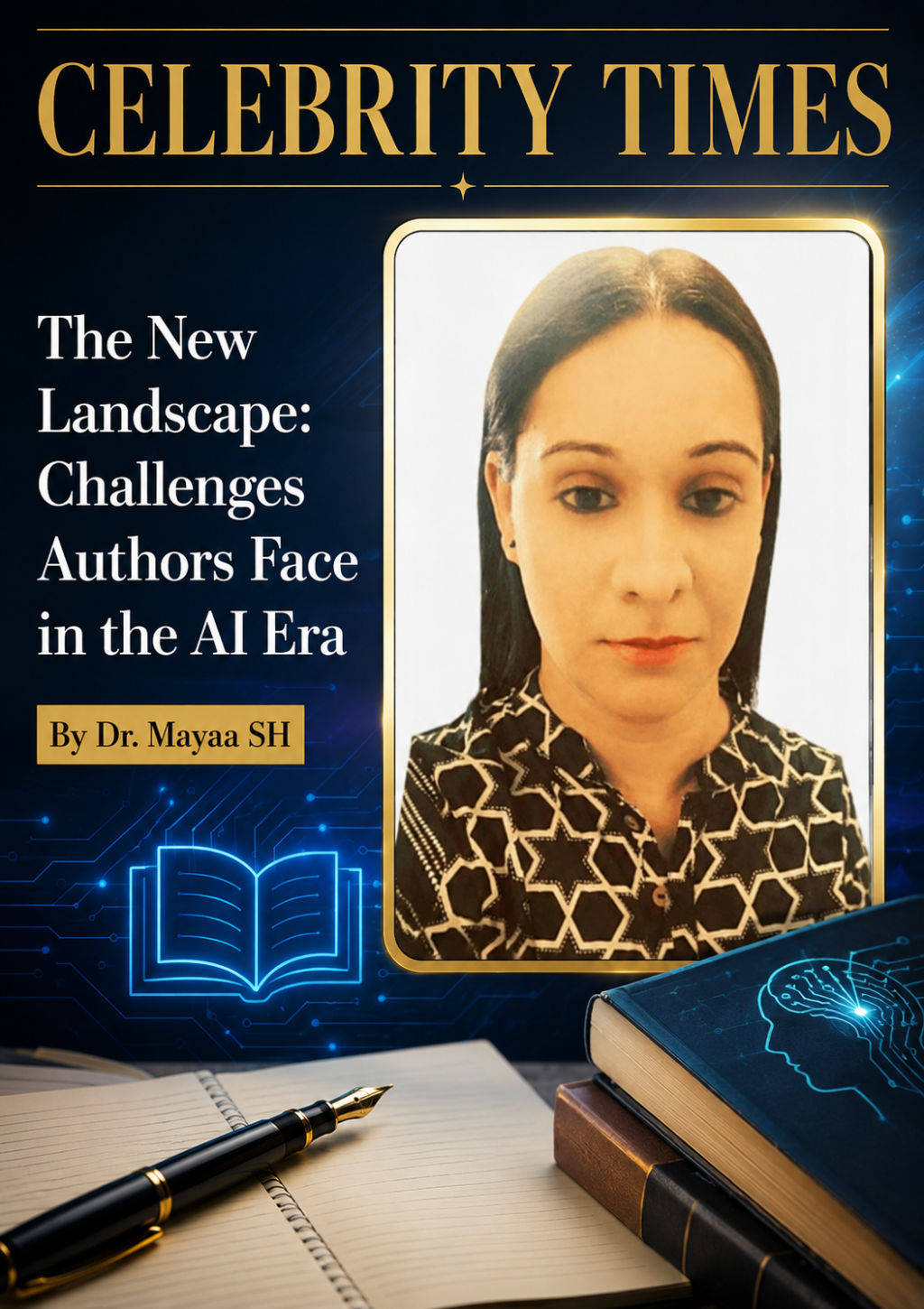
Dr Mayaa SH, widely known as Mayaa Devi, Mayaa Tai, “Lady Gandhi,” “Lady Robin Hood,” and the “MS Dhoni Of Writing,” is a distinguished contemporary Indian writer, poet, podcaster, and social reformer. Her voice resonates globally in women’s empowerment, gender parity, and mental-health advocacy. A recipient of multiple national and international honours and a thirteen times world record holder, she has authored over fourteen independent books and contributed to more than two hundred fifty anthologies, collaborating with eighty six publishing houses. Her debut, The Candle In The Wind, earned national acclaim and set the tone for transformative storytelling. In 2022, Cherry Book Awards listed her among The Modern Literary Stars of India. Anchoring her mission to the UN’s two thousand thirty Sustainable Development Goals, Dr Mayaa SH champions gender inclusivity, transgender rights, and psychological well-being through research-backed narratives. Her acclaimed works Swayam and Stamped: For Domestic Violence Survivors guide readers toward self-realization and healing by unpacking the four-phase cycle of abuse. Known as a “Firebrand Feminist” and expert in gender-based violence, she also offers social-legal counsel on matrimonial issues. As a suicide-prevention advocate, she works to erase stigma around depression and build community support. Through her podcast Purpose With A Light and extensive writings, she promotes an exponential-growth mindset, urging women to claim economic independence. By fusing literature with activism, Dr Mayaa SH has emerged as a pivotal figure in developmental feminism.
The New Landscape: Challenges Authors Face in the AI Era
The arrival of AI writing systems has redefined literature, but it has also placed authors under new pressure. The most immediate issue is oversupply. Because AI can draft an entire book in a few hours, digital marketplaces are now flooded with AI-supported titles daily. In that noise, genuine authors struggle for visibility, and distinctive storytelling often sinks beneath machine-generated output.
A second difficulty is the diminishing respect for craft. As AI convincingly mimics voice, pacing, and structure, a belief spreads that writing requires little skill. Editors and clients question whether human authors justify higher fees. Many independents report falling royalties and tighter per-word payments, as customers assume software can achieve comparable results cheaply. Years spent refining plot, character, and emotional nuance suddenly feel undervalued.
Legal uncertainty compounds the strain. AI engines train on enormous datasets that often include protected works scraped without approval. Writers fear their signature rhythm or imagery could be absorbed and reproduced, making plagiarism hard to define. With regulations still lagging, there is real unease that future novels might inadvertently reflect AI material derived from an author’s own past books.
Creative morale is also tested. Authors sense they must rival AI’s pace. The demand to release work constantly to stay noticed leads to exhaustion. When software can produce a serviceable chapter instantly, writers wrestle with self-doubt about their unique value. The quiet satisfaction of slow, deliberate composition is replaced by stress over relevance.
Financial stability has weakened. Ghostwriting, blog content, and commercial non-fiction—sectors that once provided steady earnings for mid-tier authors—are increasingly filled with AI-assisted competition. Even conventional book sales are threatened as AI summaries and spin-off texts reduce the incentive to buy originals.
Finally, reader trust is fragile. Audiences now question whether a human actually wrote the book. Authors must document their process, cultivate personal platforms, and interact directly through newsletters, talks, or social channels. Writing today involves both art and self-advocacy.
How Authors Can Overcome AI Disruption
Authors can navigate this disruption by repositioning AI as a tool, not a threat. Use it for research, structural outlines, or line editing while keeping voice, perspective, and emotional judgment distinctly human. Lived experience, cultural specificity, moral complexity, and subtle emotional nuance remain areas where human authors consistently outperform machines.
Building a recognizable personal brand is vital. Newsletters, podcasts, live events, and direct reader communities prove authenticity and create income that bypasses crowded, algorithm-driven marketplaces. Writers should diversify revenue with workshops, speaking, teaching, consulting, and membership models so they are not solely reliant on royalties now squeezed by AI-fueled saturation.
Collective action also matters. Joining or forming author unions and cooperatives can provide shared marketing, legal resources, and collective bargaining power in contracts. Basic AI literacy has become a professional skill, helping writers understand how their work might be scraped, opt out when possible, and advocate for their rights. Protecting mental health and setting a sustainable creative pace is critical to resist burnout from pressure to match AI’s speed.
What Authors Need From Government
Government support can make these adaptations viable. Copyright law should be updated to mandate consent, clear attribution, and compensation whenever an author’s work trains AI systems. A national public lending right and digital lending right would ensure payment when libraries or apps circulate AI-summarized or AI-derived versions of books.
Direct financial measures such as grants, fellowships, and tax relief for full-time writers would help offset income lost to market flooding. Publicly funded legal aid centers could assist authors with infringement claims and exploitative contracts. Transparency regulations requiring clear labelling of AI-generated or heavily AI-assisted books would let readers choose knowingly and protect human authorship.
Subsidized healthcare and pension schemes for freelance creators would address precarity worsened by automation. National writing residencies and public commissioning funds would sustain original literature beyond commercial pressures. Finally, government-backed AI literacy and skills programs would empower authors to use new tools productively without exploitation.
AI is ultimately an instrument, not a substitute. Thriving now means embracing new tools, drawing on irreplaceable personal experience, and making clear that human perspective is something no algorithm can authentically replicate.
— ©® Dr Mayaa SH
© 2026 Mayaa SH. All rights reserved.