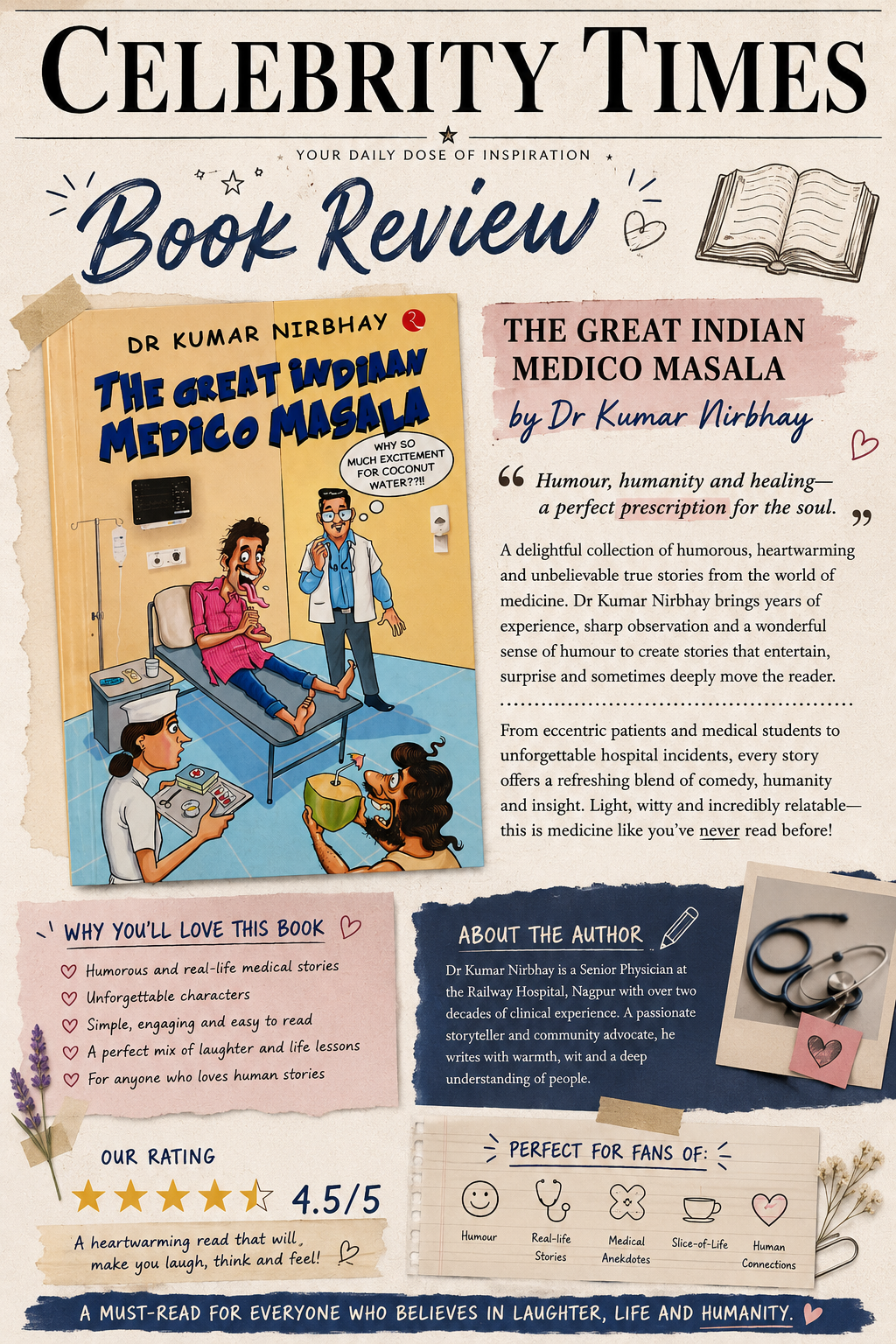
What happens when years of medical experience meet an observant storyteller, a sharp sense of humour, and the wonderfully unpredictable world of Indian hospitals? You get The Great Indian Medico Masala—a collection that turns everyday medical encounters into stories that are humorous, surprising, sometimes absurd, and occasionally deeply human.
Written by Dr Kumar Nirbhay, a Senior Physician at the Railway Hospital in Nagpur, the book draws from the author’s long clinical experience. But this is not a conventional medical book. Instead of overwhelming the reader with medical terminology, Dr Nirbhay brings the hospital to life through short, entertaining stories about doctors, patients, medical students, families, friendships and the strange situations that can unfold around medicine.
A Book That Doesn’t Take Itself Too Seriously
One of the biggest strengths of The Great Indian Medico Masala is its humour. Stories such as “The Most Nasal Reason to Become a Doctor,” “Harendra to Harry,” “The Einsteinian Alcoholic,” “The Rising Case of Hydrocele,” “Two Wives,” “The Coconut Water,” and “Headache of Twenty-Five Years” immediately suggest the wonderfully unconventional tone of the collection.
The humour often comes from ordinary situations becoming unexpectedly ridiculous. A medical student struggling through college, an unusual patient complaint, hospital misunderstandings, eccentric characters or an incident that takes a completely unexpected turn—all become material for the author’s storytelling.
What makes the humour work is that it feels rooted in real human behaviour rather than simply being written for laughs.
More Than Just Medical Jokes
Behind the comedy, there is a surprisingly thoughtful portrait of medicine.
The stories repeatedly return to the relationship between doctor and patient. The hospital is presented not simply as a place of illness and treatment, but as a place where personalities, fears, expectations, desperation and hope all collide.
This becomes particularly evident in stories such as “The Priority Patient,” “God Is Watching Everything,” “The Signature,” and “Dr Ravan.” The doctor is not portrayed as an all-knowing figure standing outside the patient’s world. Instead, doctors themselves become part of the chaos—trying to diagnose, communicate, improvise and sometimes simply understand what is happening.
There is also an affectionate look at medical students and young doctors. Their exhaustion, ambition, friendships, mistakes and sometimes bizarre adventures give the book another dimension. The medical college setting becomes almost a character of its own.
The Characters Are the Heart of the Book
Perhaps the most enjoyable aspect of the collection is its cast of characters.
From patients with unusual problems to eccentric students and unforgettable hospital personalities, Dr Nirbhay doesn’t seem interested in creating perfectly polished characters. Instead, he embraces their quirks.
That is what makes many of the stories memorable.
The characters can be foolish, dramatic, stubborn, frightened, mischievous or completely unpredictable—and sometimes all of these at once. Yet beneath the comedy, there is often compassion. The author clearly understands that patients are not merely medical cases; they are people with their own stories.
The Writing Style
The writing is simple, conversational and accessible, which works particularly well for this kind of collection. The chapters are relatively short, making the book easy to pick up and read in small portions.
I also liked the way the chapter titles create curiosity. Titles such as “Pneumothorax,” “Anti-ballistic Missile,” “The Hair Trimmer,” “The Spanish Lady,” and “What Is Today?” make you wonder what possible connection they could have with a medical story.
And that curiosity becomes part of the reading experience.
The author also doesn’t restrict himself to one kind of story. Some chapters are primarily comic, some are built around medical incidents, while others become more reflective. This variety keeps the collection from feeling repetitive.
What I Particularly Liked
What stayed with me most was the book’s ability to find humour in the everyday.
Medicine is often associated with seriousness, stress and difficult decisions. Dr Nirbhay shows another side of it—the absurd conversations, unexpected patients, memorable colleagues and incidents that doctors may remember long after the clinical details have faded.
At the same time, the book never completely loses sight of the seriousness of the profession. Beneath the laughter is an understanding of responsibility, human vulnerability and the trust patients place in their doctors.
The illustrations and playful presentation also complement the tone of the book and reinforce its light-hearted personality.
Final Verdict
The Great Indian Medico Masala is best approached not as a medical textbook but as a collection of stories from the human side of medicine.
It is funny without being entirely frivolous, medical without becoming technical, and personal without becoming overly sentimental.
For readers who enjoy Indian humour, slice-of-life stories, medical anecdotes and unusual real-world characters, this book offers an entertaining change of pace. And even if you have never stepped inside a medical college or hospital, the stories work because their real subject is something much more universal: people and the wonderfully unpredictable things they do.