
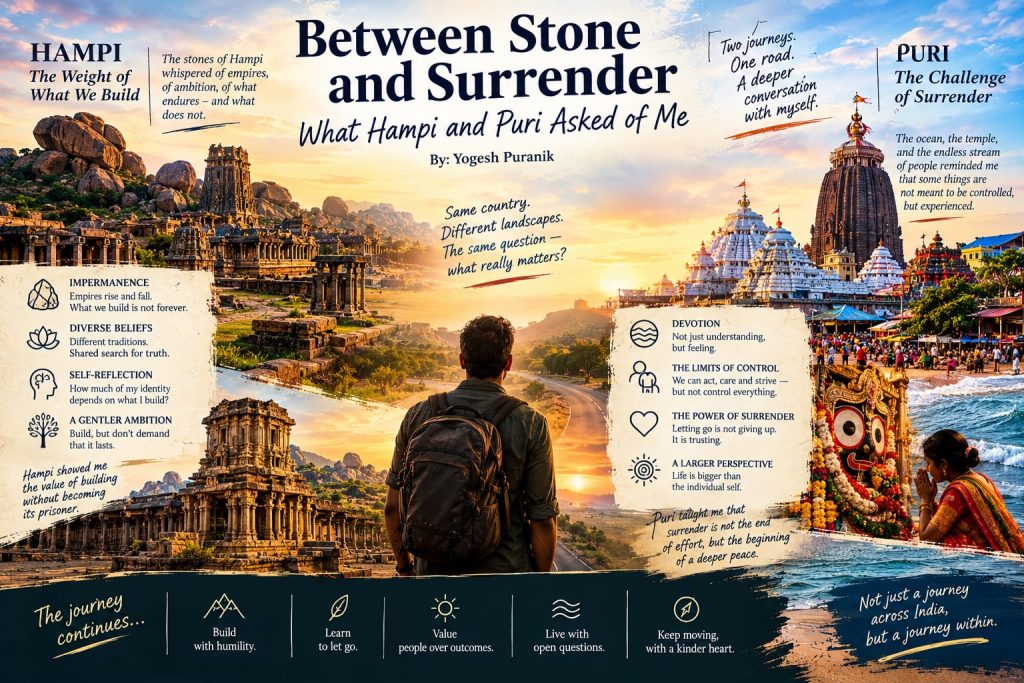
Hampi: The Weight of What We Build
My first impression of Hampi was of a landscape that seemed to belong to a time before human history had acquired its present shape. Enormous boulders lay scattered across the terrain, balanced upon one another in improbable formations. Some rose above the earth like weathered monuments; others appeared to have tumbled into place and remained there through centuries of wind, rain, and heat. The morning light settled upon their rough surfaces, revealing shades of grey, brown, and muted gold.
Between these ancient formations lay the remains of Vijayanagara, once among the most powerful and prosperous cities of southern India. The ruins did not announce themselves all at once. They appeared gradually as I walked, a weathered pillar here, a row of stone columns there, the remains of a marketplace, the outline of a pavilion, the carved walls of a temple whose builders had long since returned to the earth.
What struck me most was the scale of the place. Hampi was not simply a collection of old monuments. It was the remnant of an entire world, one that had once possessed its own rhythms of commerce, worship, politics, artistic expression, and ordinary human life. The stones had outlived the people who had given them meaning, and yet they were not entirely emptied of it.
The Virupaksha Temple, still alive with worship, stood in striking contrast to the surrounding ruins. Its continued presence seemed to interrupt the overwhelming impression of disappearance. Here, amid the remains of an imperial capital, prayers were still offered, rituals were still performed, and generations of devotion continued to find expression. The past was not entirely past. It had left behind something that remained capable of gathering the living.
As I stood among the ruins, I found myself thinking about the strange confidence with which human beings build their worlds. We construct homes, institutions, careers, reputations, and identities as though the act of building itself might offer some protection against the uncertainties of existence. We invest our time and imagination in these structures, gradually allowing them to become extensions of who we believe ourselves to be.
There is nothing inherently wrong with this. To build is to participate in life. To work towards something, to create, to aspire, and to leave something of oneself behind are deeply human impulses. But somewhere along the way, the things we build can begin to define the people we think we must become.
I wondered how many of the men and women who had lived in Vijayanagara had once believed their world would endure. How many had measured their worth through the prosperity of their households, the authority of their positions, or the recognition their achievements brought them? Their lives had unfolded amid a civilisation whose grandeur must have seemed, to those living within it, as substantial and enduring as the stone beneath their feet.
And yet, the capital had suffered devastation following the Battle of Talikota in 1565. Its monumental structures survived in fragments, while the political centre that had given them much of their purpose fell into ruin. The Vijayanagara state itself continued under later rulers, but the city could no longer command the world that had once gathered around it.
Standing there, I could not help turning the question towards myself. How much of my identity depended upon things that might one day disappear? How much of my sense of worth rested upon professional achievements, financial security, recognition, or the reassuring belief that I was steadily moving towards a life I had planned?
It would have been easy to leave Hampi with the familiar conclusion that everything is temporary and that, therefore, nothing deserves our attachment. The ruins seemed to offer themselves readily to such a reading. But I began to suspect that this would be too convenient a lesson, one that mistook the recognition of impermanence for the wisdom of indifference.
The fact that something will not last does not necessarily make it meaningless. A life is no less valuable because it ends. A work of art is not diminished by the knowledge that it will eventually decay. Nor does the uncertainty of success make sincere effort a wasted undertaking.
Perhaps the difficulty lies elsewhere. We may need to build, but must we also demand that what we build should endure? Can we care deeply about our work without allowing its outcome to become the final measure of our worth?
As I considered these questions, another aspect of Vijayanagara’s history came to mind. The empire’s religious and intellectual life had not been shaped by a single, unquestioned understanding of existence. Different Hindu traditions, including the Advaita tradition associated with Sringeri, the Dvaita tradition of Madhva, and Sri Vaishnava institutions, received patronage at different times. Their relationships with the court were complex, shaped by devotion, intellectual debate, and the changing interests of rulers.
These traditions disagreed about fundamental questions concerning the self, the world, and the divine. Advaita understood ultimate reality through nonduality, while Dvaita insisted upon a real distinction between God and the individual soul. Sri Vaishnavism offered its own account of the relationship between the individual, the world, and the divine.
I found something compelling in the thought that this great imperial centre had also been a place where different understandings of reality were cultivated and contested. The city had not merely housed power. It had been part of a larger human endeavour to make sense of existence itself.
The thought brought me to another question, one that felt closer to my everyday life than the fate of any empire. How often did I mistake my own understanding of the world for the only reasonable way of seeing it? How readily did I defend my convictions when they were challenged, not because I had examined them carefully, but because they had become inseparable from my sense of self?
We speak of open-mindedness as though it were an uncomplicated virtue. In practice, it can be difficult to allow another person to disagree with us without feeling that something essential within us has been threatened. We build intellectual structures with much the same care with which we build our external lives, and sometimes defend them with equal anxiety.
Hampi made me wonder whether the strength of a belief lies partly in our willingness to examine it, rather than merely in our determination to preserve it.
I did not leave the ruins with a newfound indifference towards ambition or a sudden ability to accept every uncertainty. I still wanted to work, to grow, and to build a life that felt meaningful. But I began to consider the possibility that these desires need not be accompanied by the insistence that everything must unfold according to my expectations.
Perhaps the lesson of the stones was not that we should cease building. It was that we should learn to build without imagining ourselves masters of time.
The boulders remained where they had been for centuries, indifferent to my reflections. I left them behind, carrying the uneasy recognition that the structures most difficult to relinquish might not be the ones we construct with our hands, but the ones we construct within ourselves.
Puri: The Challenge of Surrender
Months later, I found myself driving towards Puri, moving through a landscape that seemed to belong to an entirely different world. The dry expanses and rocky horizons of Hampi gave way to the humid air of coastal Odisha. The wind carried the faint suggestion of salt, and the roads grew busier as I approached the pilgrimage town. There was a restlessness to Puri that I had not encountered in the quiet spaces of Hampi.
People moved through its streets in a steady current. Families travelled together, vendors called out to passers-by, and pilgrims made their way towards the temple with an anticipation that seemed to give direction to the surrounding activity. The town did not feel like a place preserved from time. It felt like a place in which time was continually being renewed through the arrival of people, the repetition of rituals, and the persistence of faith.
The Jagannath Temple rose above the surrounding streets, its towering sanctuary unmistakable against the sky. The architecture carried the authority of the Kalinga tradition, but the temple’s significance seemed to extend well beyond its physical grandeur. Its presence was felt in the movement of people towards it, in the gestures of reverence, and in the sense that countless private hopes and anxieties were being brought into the orbit of something larger than the individual.
At Hampi, I had walked among the remains of a world whose political centre had fallen silent. At Puri, I encountered a sacred centre whose influence continued to draw people towards it. One place had made me think about what time takes away. The other made me wonder what allows meaning to endure.
The history of the Jagannath Temple is itself a story of continuity and transformation. The great temple is associated with the Eastern Ganga ruler Anantavarman Chodaganga Deva, whose reign in the twelfth century marked an important phase in its development. In the thirteenth century, his successor Anangabhima III further shaped the relationship between Jagannath worship and kingship, placing the deity at the centre of the kingdom’s political imagination.
The significance of this relationship stayed with me. Here was a tradition in which royal authority could be understood as existing under the sovereignty of the divine. A king might possess the power to command armies, administer a kingdom, and shape the fortunes of his subjects, yet his authority could also be represented as subordinate to a sacred presence greater than himself.
I found myself thinking of Hampi again. Empires rise through the efforts of human beings who seek to establish order, exercise power, and leave their mark upon history. Yet the histories of these two places suggested that power does not always determine the meaning that survives it. At Hampi, the continuing worship at Virupaksha outlasted the political fortunes of Vijayanagara. At Puri, the relationship between kingship and Jagannath had given political authority a language of service and submission to the divine.
The two histories were different, but both complicated the assumption that those who exercise power must also possess the final word.
I have always been inclined towards understanding things through thought and reflection. When something moves me, my instinct is to search for its underlying structure, to read its history, to discover the ideas that might explain its significance. There is comfort in believing that sufficient understanding will eventually make an experience intelligible, perhaps even manageable.
Puri made me question that comfort.
The religious life of the Jagannath tradition had been shaped by many influences over the centuries. Among them was the devotional movement associated with Chaitanya, who spent the latter part of his life in Puri. His tradition placed extraordinary emphasis on loving devotion to Krishna, expressed through longing, remembrance, worship, and surrender. It did not simply replace thought with emotion. Rather, it placed a different emphasis upon the relationship between the devotee and the divine, making love itself a way of approaching spiritual truth.
I found myself drawn to this distinction because it touched upon something I had rarely examined in my own life. I had spent considerable time trying to understand myself, to identify the principles by which I should live, and to make sense of the world through reflection. But understanding can also become a way of maintaining distance. If I can analyse an experience, I can remain its observer. If I can explain a disappointment, perhaps I need not fully feel it. If I can find a reason for uncertainty, perhaps I can avoid the discomfort of not knowing.
There are moments when the mind becomes less an instrument of discovery than a means of protection.
Standing amid the movement of devotees, I began to wonder whether I had sometimes mistaken the desire to understand life for the desire to keep it at a safe distance. I could think about humility without allowing myself to be humbled. I could admire surrender without relinquishing the belief that I should remain in control. I could speak of the limits of the individual self while continuing to organise my days around its anxieties and ambitions.
The crowd around me offered no single answer. Each person had arrived with a private history, a different burden, a hope that might never be spoken aloud. I could not know what faith meant to each of them, nor did I wish to imagine that devotion automatically resolved the contradictions of human life. But there was something moving in the sight of so many people turning towards a sacred presence, bringing with them concerns that could not all be settled by reason or effort alone.
For a moment, the boundaries of my own preoccupations seemed less absolute.
I began to think of surrender not as the abandonment of responsibility, but as the recognition that responsibility has limits. We can work towards a desired outcome without possessing the power to guarantee it. We can care for another person without determining the course of their life. We can act with conviction without assuming that every disagreement must end in our favour.
The distinction sounds simple when expressed in words. Living by it is another matter.
Much of what we call control is sustained by fear. We fear failure, so we become anxious about every result. We fear being misunderstood, so we try to manage the perceptions of others. We fear uncertainty, so we spend our days attempting to anticipate events that may never occur. Even our efforts at self-improvement can become another means of protecting ourselves from the unpredictable nature of being alive.
I recognised some of these tendencies in myself. I could see how easily a reasonable desire to do well became an insistence upon getting things right, and how that insistence could leave little room for disappointment, ambiguity, or the possibility that another person’s way of seeing the world might be as valid as my own.
Puri did not make these habits disappear. Nor did I experience some sudden release from the need to control my circumstances. A visit to a sacred place does not automatically transform the person who visits it. Sometimes, the only honest result of an encounter is the discovery of how much remains unchanged within us.
Yet the question had become harder to ignore. If life is larger than my individual plans, why do I so often behave as though every outcome must pass through my hands?
Perhaps surrender begins with the willingness to recognise this contradiction. It does not require us to stop acting, caring, or striving. It asks whether we can continue to do these things without making the world answerable to our expectations.
As I moved away from the temple, the sounds of the town seemed to gather around me once more. The traffic continued, people went about their business, and the ordinary world resumed its claim upon my attention. Nothing around me suggested that a profound transformation had taken place. But I carried with me a question that had become more personal than any philosophical proposition I might have encountered in a book.
Could I learn to participate fully in my life without insisting upon controlling all of it?
I had gone to Puri thinking that meaning might be found through a deeper understanding of the self. I left wondering whether, at times, it might also be found in the willingness to loosen one’s grip upon it.
The Return
On the drive back to Jabalpur, the silence of the car felt different from the silence with which these journeys had begun. It was no longer simply an empty space in which to examine my life from a distance. It had become a place in which certain questions continued to accompany me, refusing to settle into convenient conclusions.
I did not return from Hampi and Puri with a philosophy that neatly reconciled the two. I had not become indifferent to professional success, nor had I acquired some lasting ability to surrender my anxieties. The changes, if they could be called changes, were smaller and less certain.
I found myself thinking a little differently about the work I did. I still wanted to accomplish things, to grow, and to feel that my efforts were meaningful. But I was beginning to question why every setback should carry the weight of a personal judgement. Perhaps it was possible to care about the quality of one’s work without allowing its success or failure to determine the quality of one’s life.
I also began to notice my own need for control in ordinary situations. It surfaced in impatience, in disagreements, in the desire to settle uncertainties before they had run their course. Recognising these habits did not make them disappear, but it occasionally allowed me to pause before mistaking them for necessities.
I suspect that this is often how the more enduring effects of travel reveal themselves. Not through dramatic revelations or sudden changes in character, but through small alterations in the way we respond to familiar circumstances. A place leaves its mark not necessarily because it has given us an answer, but because it has made an old question more difficult to ignore.
I think often of the contrast between Hampi and Puri. At Hampi, the stones seemed to speak of the distance between human ambition and the passage of time. At Puri, the living presence of devotion suggested that meaning might also be sustained through relationships, rituals, and forms of surrender that extend beyond the individual.
One place asked what remains of what we build. The other asked what becomes possible when we loosen our insistence upon control.
Yet I hesitate to reduce either place to a lesson. Hampi is more than a monument to impermanence, just as Puri is more than a symbol of surrender. Their histories are too complex, their living traditions too expansive, to be contained by the conclusions of a single traveller. Perhaps part of the value of encountering such places lies in discovering that they remain greater than our interpretations of them.
We preserve monuments because they carry histories that might otherwise become difficult to imagine. We study them because the past is not simply a vanished world, but a presence that continues to shape the questions we ask in the present. To write about these places is, in some small way, to participate in that act of remembrance.
But remembrance might ask something more of us than the ability to describe what our ancestors built or believed. Perhaps it asks us to consider what their lives reveal about our own ambitions, our convictions, and our recurring desire to make the uncertain world more manageable than it can ever be.
I began these journeys hoping to encounter the grandeur of ancient India. I found it in the immense stones of Hampi and in the enduring pull of Puri’s sacred landscape. What I had not anticipated was that these places would turn my attention towards the quieter architecture of my own life, the beliefs, ambitions, and anxieties through which I had tried to construct a sense of permanence.
I still do not know how to balance ambition with detachment, or understanding with surrender. Perhaps these are not questions that can be answered once and then left behind. They return in different forms, in the work we pursue, the people we love, the disagreements we struggle to accept, and the losses we cannot prevent.
Hampi asked me what remains of what I build. Puri asked me what happens when I stop insisting on being in control.
The road between them has not resolved either question. It has only made me more willing to live with them.
And perhaps, for now, that is enough.
About the Author

Yogesh Arvind Puranik is an award-winning Indian author, poet, educationist, and investor who leverages over 25 years of corporate leadership experience to enrich his expansive literary portfolio. A certified management and product professional, he has published more than twenty books traversing fiction, poetry, philosophy, and reflective writing. His celebrated catalog features The House of Anand Rathore and Decoding The Ramayana, alongside evocative titles such as The Forgotten Name of Kalki, Whispers of the Soul, House of Stories: Mira’s Chronicles, No More Almost: The Space Between Breaths, Speak The Names: The Silence Is the Sin, The Smell of Crushed Jasmine, The Curse of the Gatekeeper: A Gödel Investigation, The Eclipse Paradox, The Clockmaker’s Delirium, The Void Between Inheritors, and The Tides That Remember.
Readers are invited to download his free eBook, Profound Life Lessons,
You may explore his complete literary collection on his Amazon Kindle Author Page.