
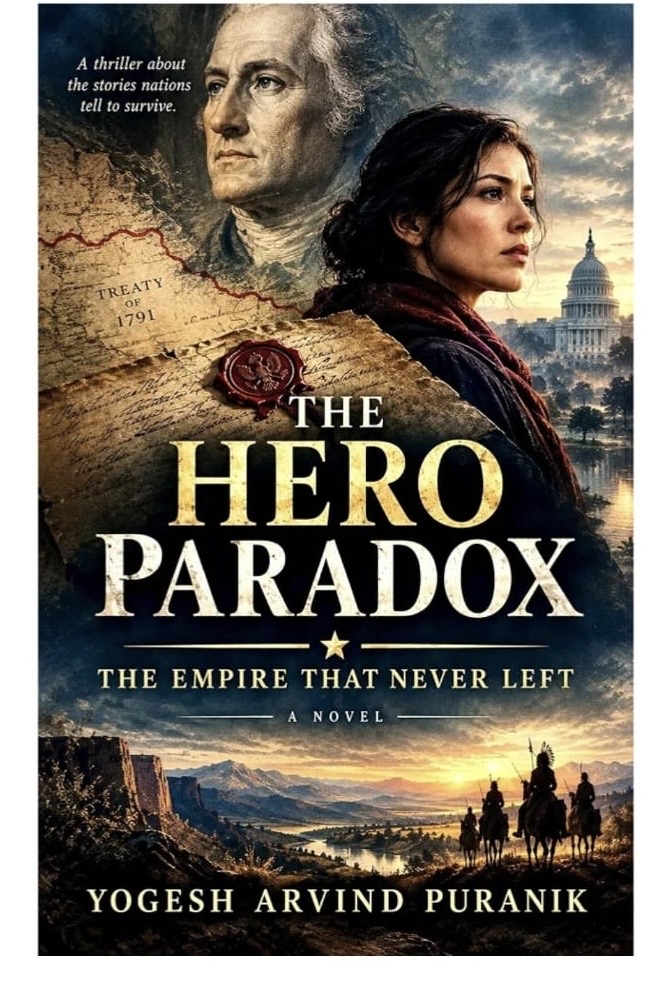
History is written by the victors, or so we’re told. But what if the ink was paid for with a traitor’s gold? That question runs through Yogesh Arvind Puranik’s latest novel, The Hero Paradox: The Empire That Never Left. In the last few weeks, the historical thriller has climbed to number one in Indigenous Literature and Fiction on Amazon Kindle, and it got there without much help from traditional publishing. I don’t think that’s an accident. There are plenty of readers right now who’ve lost patience with tidy national mythologies.
The story opens with Dr. Edmund Pendelton, who has spent forty years as something like the high priest of the American myth. He writes biographies of Alexander Sterling, the Founding Father credited with taming the wilderness, and he has done very well out of it. He’s comfortable, respected, and he honestly believes what he writes. Then, at a lavish Fourth of July gala, an encrypted message lands on his phone: a high-resolution scan of a document dated October 12, 1791.
It’s a surrender treaty. Sterling signed it himself, alongside two Native leaders whose names were later scrubbed out, and it hands half the continent to a sovereign Indigenous nation. In the Founding Father’s own hand, the young Republic admits it lost.
If the treaty is real, and the ink and signatures say it is, then the “glorious battle” that every American textbook places three weeks later never happened the way we were taught.
Puranik takes us back to the freezing, dangerous world of 1791 to show how the lie was built. There we meet Chayton, the Falcon, an Indigenous visionary trying to turn a dream into a recognized nation, with a standing army, a written constitution and a capital at Kekionga. His oldest friend, Tokala the Fox, sees what Chayton won’t: empires don’t bother with walls when they can buy the men standing guard. Sterling offers fifty thousand guineas. Tokala has to choose between dying beautifully for a doomed nation and living a damned life to protect his daughter. I found that choice hard to shake.
What impressed me most is how Puranik links Tokala’s dilemma to the polished courtrooms of present-day Washington, D.C. Pendelton, now hunted by the very institutions he spent his career praising, ends up on the run. He teams up, uneasily, with Sarah Walker, a fiercely committed Native rights attorney. Together they follow a two-hundred-year-old paper trail from a blind trust in Philadelphia into the endowments of elite universities, media conglomerates and philanthropic foundations. The empire never faded. It incorporated.
For Sarah, it gets painfully personal, and Puranik doesn’t spare her. She learns she descends from both the man who opened the gates and the people he betrayed. Worse, her whole career fighting for Indigenous justice has been quietly funded by the family that profited from her ancestors’ slaughter. It’s a gut punch of a twist, and it’s what lifts the book out of the standard historical mystery and into a real reckoning with complicity. As Diane Smith, one of the novel’s key characters, puts it: “A nation that requires a foundational lie to survive is not a democracy. It is a cult.“
Running two timelines, a pile of historical detail and a fast pace all at once is hard, and Puranik makes it look easy. Maybe that’s experience. He lives in Jabalpur, India, and brings an outsider’s eye to American history that feels fresh. He spent twenty-five years in corporate management and has written more than twenty books, and you can feel it in how convincingly he writes about power, money and influence. His recent honors, including the 21st Century Emily Dickinson Award and the International Author Excellence Award, suggest a writer who has found his stride.
The Hero Paradox is a commercial success, but it’s also a sharp and necessary look at the stories we tell to justify the ground beneath our feet. At a time when history is argued over almost daily, Puranik reminds us that the truth doesn’t disappear. It waits in the dark and gathers interest.