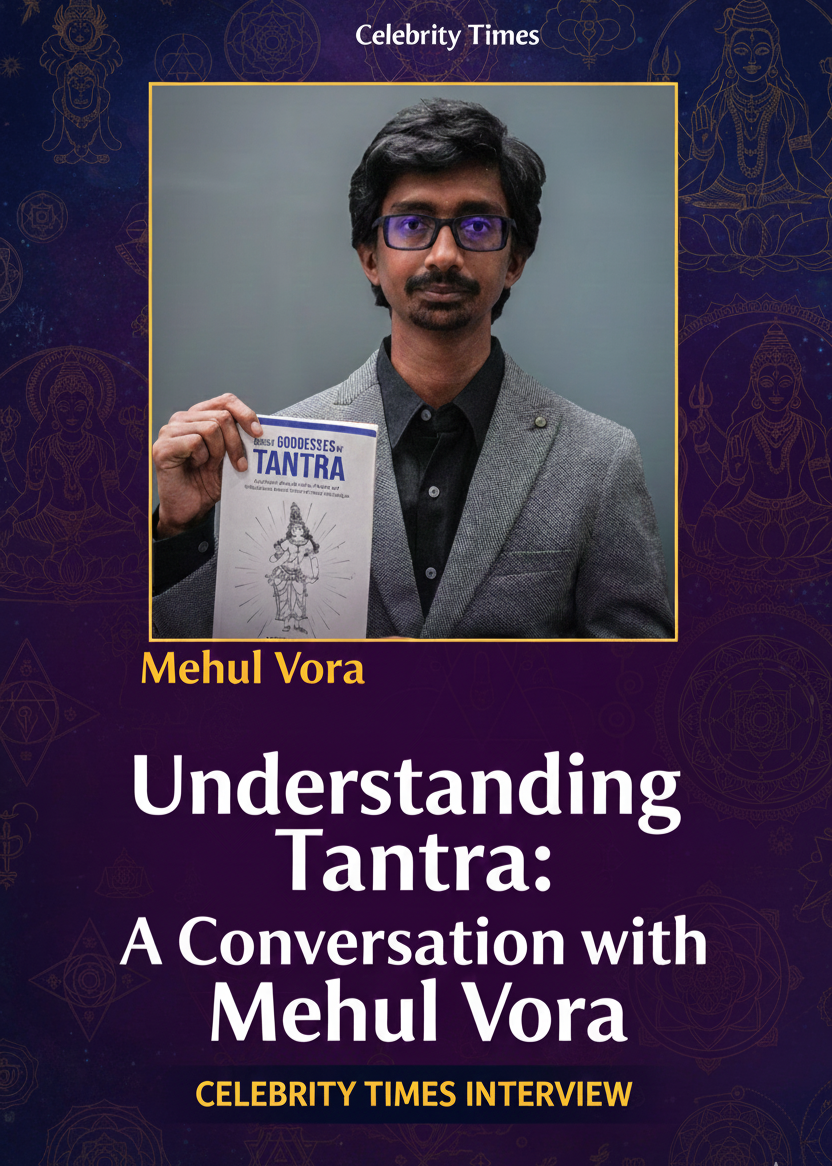
Mehul Vora is a Tantra scholar and author known for his in-depth understanding of the science and sacred art of Tantra. His book, The Secret Goddess of Tantra, presents classical Tantric knowledge with clarity, drawing from Agamas, Puranas, and core Tantra texts. Through disciplined study of yantra, mantra, sadhana, and guru-parampara, he bridges ancient spiritual systems with contemporary insight.
Q1: How does yantras work?
Yantras can be thought of as the addresses or maps for deities, while mantras serve as their names. The Kulārṇava Tantra mentions that just like our body relies on a soul, spiritual practice (sadhana) requires a yantra. That’s because a deity and its yantra are interconnected—once a yantra is properly set up, it transforms into a living embodiment of that divine energy.
A yantra acts like a potent energy vortex. It collects and boosts the energies produced through sadhana. For any spiritual practice to thrive, one needs to connect with the deity through both the mantra and the yantra. Since yantras operate like spiritual machines, they can create and store substantial power, which makes them a crucial foundation of sadhana. In fact, every sadhana relies on three pillars: Mantra, Yantra, and Yagya, with the yantra being the most vital of the three.
Interestingly, yantras are also found within our own bodies. The chakras are referred to as śarīra yantras since each chakra energizes a particular area, much like how external yantras energize the surroundings and the practitioner.
There are various types of yantras, each designed for specific purposes:
- Dharana Yantras – worn around the neck for protection or to gain specific benefits.
- Chatra Yantras – placed on roofs or in hidden spots, like Vastu Dosh Nivaran yantras.
- Mandala Yantras – created in larger designs for group practices, such as hawan kunds shaped like yantras.
- Darshan Yantras – displayed visibly to attract or influence, like Aakarshan or customer-attraction yantras.
In general, yantras fall into two main categories:
- Sadhana Yantras: These are dedicated to spiritual worship. For instance, if someone is performing the sadhana of Bagalamukhi or Kali, the yantra needs to be correctly established before mantra recitation and subsequent yagya.
- Prayog Yantras: These function based on intentions and are used for practical purposes like fixing Vastu issues, attracting wealth, boosting business, or fulfilling particular desires.
To sum it up, sadhana can’t be fully realized without the yantra. Just receiving a mantra isn’t enough. The yantra secures the deity’s presence, holds the practice’s energy, and makes the sadhana effective and transformative.
Q2: Among several religious places you have visited, which is your favourite religious place? And why?
I have had the opportunity to visit many sacred places across India—Jagannath Puri, Dakshineshwar, Tarapeeth, Tara Tarini, Ugratara, several temples in South India, Vrindavan, and many others. Each Dham or Tirthasthala holds its own unique energy, so I do not see one as my favourite over another.
Every sacred site—whether it is a Shaiva, Shakta, or Vaishnava centre—has its own mood and spiritual vibration. What truly matters is the bhava, the inner attitude, with which we visit. In Vrindavan, the heart naturally turns toward the divine pastimes of Krishna; in Ahobilam, the focus becomes pleasing Lord Narasimha; and in places like Dakshineshwar or Birbhum, the devotion flows toward the Divine Mother. One place especially close to my heart is Pavagadh in Gujarat, which I try to visit every two months.
These visits are important because daily life exposes us to stress, negativity, and unnecessary conversations that settle like dust on the heart. A Dham provides a much higher energy, which helps cleanse and uplift us. Our scriptures also emphasise this—Skanda Purana and Padma Purana both describe the immense significance of Tirthas, calling them powerful sources of spiritual energy.
The experience of a Dham is very different from that of an ordinary temple. The energy is deeper, stronger, and transformative. Visiting such sacred spaces is essential for inner purification and spiritual growth.
Q3; Why has the school of Tantra Not popularised in the way the Vaishnava sect is?
Across Indian spiritual traditions, different schools have grown in different ways. For example, Advaita Vedanta taught by Adi Shankaracharya is highly respected, but it did not spread as widely as the Vaishnava traditions. The reason is simple: Vaishnavas focused strongly on preaching.
Among the four Vaishnava sampradayas—Madhva-Gaudiya, Sri Vaishnava (Ramanujacharya), Nimbarka, and Vallabha—the Sri Vaishnava and Madhva-Gaudiya traditions became especially prominent. South India is filled with Sri Vaishnava temples, and Bengal saw powerful Vaishnava preaching under Chaitanya Mahaprabhu. His Six Goswamis rediscovered the sacred sites of Vrindavan when it had almost disappeared. Later, Srila Prabhupada carried this movement worldwide. Gujarat, through Vallabhacharya’s Pushti Marg, also saw strong Vaishnava influence.
Tantra, on the other hand, never focused on preaching. Unlike Vaishnavism or Advaita, which are easier to communicate through philosophy or devotion, Tantra involves strict rules, complex rituals, and practices that were not always accepted by mainstream Brahminical society. Ritual elements like meat or alcohol—allowed in some Tantric traditions—were discouraged due to growing influence of Jain and Buddhist ideals of purity. As a result, many Tantric lineages declined or remained underground.
Today, because of social media, we see a renewed interest in Tantra—Baglamukhi, Kali, and many other traditions are becoming more visible. Yet Tantra remains widely misunderstood. Many people associate it with black magic or, due to Osho’s interpretations, with sexuality. In reality, classical Tantra has no connection with sex, tantric massage, or eroticism.
At its core, Tantra is simply a disciplined and systematic method of worship. It includes yantra sthapana, yantra puja, mantra japa, meditation, tapasya, and yagya—performed in a structured way.
Any deity can be worshipped through Tantra: Vishnu, Rama, Krishna, Lakshmi (Lakshmi Tantra), the Mahavidyas, Bhairava, Ganapati, or Hanuman. When done with purity and correct intention, Tantra is a powerful, sacred path.
Q4: How many scriptures does one have to go through to learn the basics of Tantra .Which scripture or reading is a must ?
If you want clarity on these subjects, the best place to start is my book. I have already done the reading and research for you. The Secret Goddess of Tantra and my upcoming book on decoding mantras both present the teachings in simple language while staying true to the original scriptures.
Translating Sanskrit to English can easily change the meaning, so I have tried to bridge that gap. I give the shlokas in Roman script so that everyone can read them. I also provide clear explanations supported by proper references.
I have studied widely — the Vedas, Upanishads, Atmabodha, Bhagavad Gita, Bhagavatam, Padma Purana, Garuda Purana, as well as important Tantra texts like Kularṇava Tantra, Paratōshini Tantra, Lakshmi Tantra, and Baglamukhi Tantra Rahasya. My work brings these references together.
Each Tantra text gives a different perspective. For example, Devi Kali is described differently in the Garuda Purana, in regional poetry, and in the Rudra Yamala Tantra. I have drawn these parallels so readers can understand the full picture of the Dasha Mahavidyas and the wider Tantra tradition.
Tantra is a vast subject. Different deities have their own texts, and many of these teachings trace back to the Agamas, which are considered older than the Vedas. The Agamas are believed to be the direct words of Lord Shiva, heard by Devi Parvati, and they form the foundation of the Tantras.
Q5: Does Tantra practice have hazards as it’s mentioned that it’s suited to be best done under a Guru?
Let me give a simple example. If you want to learn surgery, you must go to medical school. You cannot learn it from YouTube. The same is true for law, engineering, or architecture. Even if someone dreams that they received a degree, they still cannot practise. These subjects require proper training, guidance, and supervised practice.
You may find surgery videos or engineering tutorials online, but you cannot copy them and start performing operations or building bridges. You need a trained expert — a surgeon, a lawyer, an engineer — to teach you.
If every complex field needs a teacher, why should spirituality or Tantra be any different? Trying these practices without proper guidance can be risky, just like mixing chemicals in a lab without understanding them.
In simple terms, a guru is an expert — someone who has done the practice, gained experience, and can now guide others safely. This principle applies not only to Tantra, but to every spiritual path.