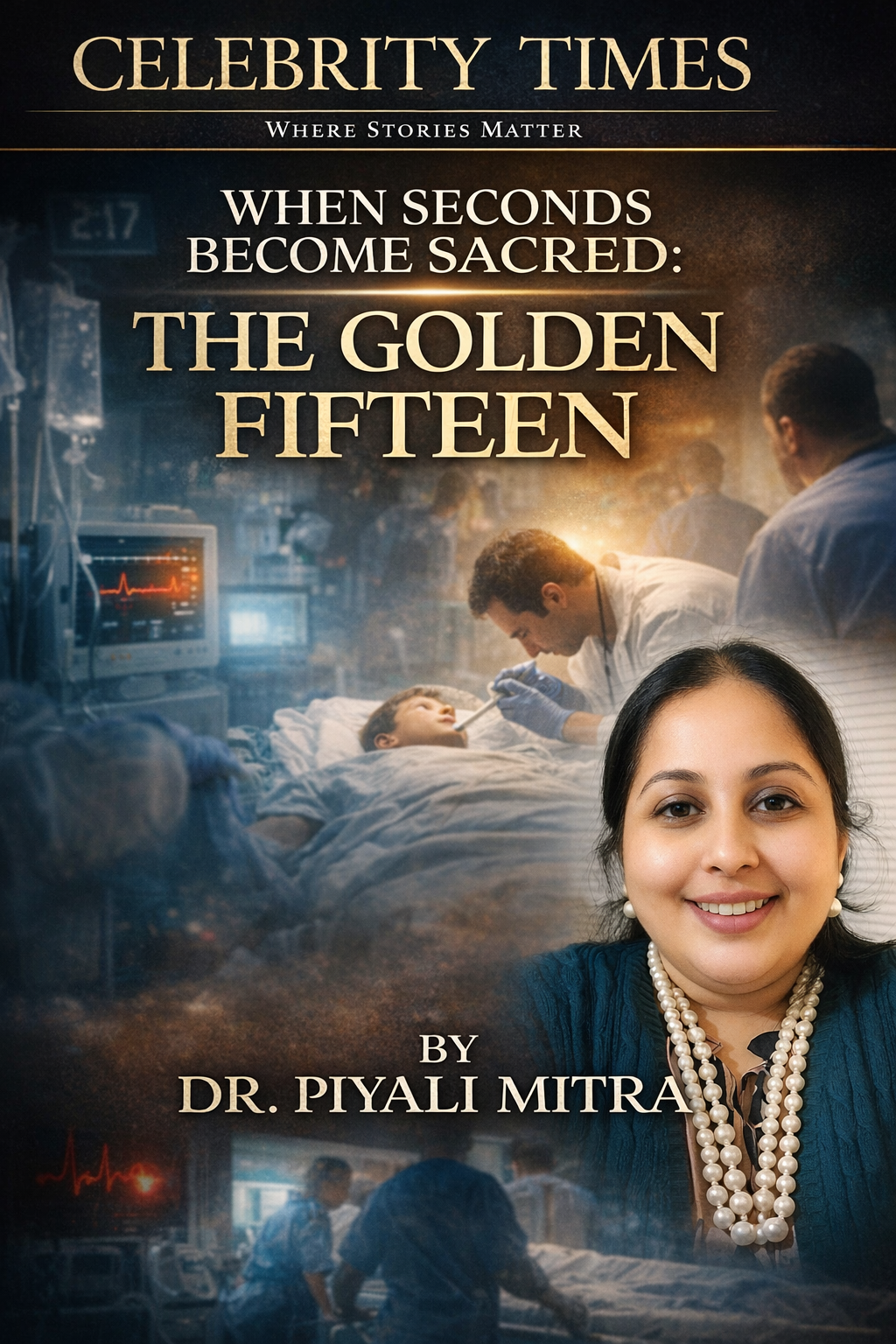
There is a moment in every medical emergency when time changes shape.
It thickens.
It slows.
It sharpens into something almost holy.
At 2:17 a.m., the phone rang.
Dr. Aritra Sen had been asleep for exactly forty-three minutes. He knew because he had
checked the clock before closing his eyes, promising himself that tonight, at least, would be
quiet. The ringtone cut through the darkness with surgical precision—merciless, unwavering.
“Sir, twelve-year-old male. High fever, altered consciousness. ETA five minutes.”
He was awake before the call ended.
Years of emergency medicine had trained his body to move before thought caught up. Feet
into shoes. Shirt buttoned wrong, then corrected. Keys. Phone. The night outside was heavy
and windless; the city wrapped in a fragile illusion of peace.
By 2:23 a.m., the emergency department was humming under fluorescent light. The night
carried its own smell—antiseptic, exhaustion, and something metallic that no one ever
named. Machines glowed softly, their screens waiting like quiet sentinels.
In emergencies, the world reduces itself to pulse, breath, and the fragile rhythm of a heart that
must not stop.
The doors burst open.
The stretcher rolled in like a tide refusing to retreat.
The boy arrived pale, his mother’s sari crumpled and damp with sweat. Her hair had come
undone; her eyes were wide with disbelief.
“He was talking… he was fine… he was just talking,” she kept repeating, as if language
might reverse time.
The child’s eyes fluttered without focus. His breathing was rapid, shallow. His skin burned
under the nurse’s palm.
“Temperature?” Aritra asked.
“104.8.”
“Pulse?”
“140.”
“BP dropping.”
The golden fifteen minutes had begun.
There is choreography in an emergency room. Not panic—precision. Nurses move like steady
constellations. The junior resident stands ready; adrenaline masked as composure. Voices
overlap—measured, urgent, practiced.
“Prepare oxygen.”
“IV line ready.”
“BP falling further.”
Aritra leaned closer. The boy’s neck resisted movement. A rash—tiny red specks—was spreading like spilled ink across his arms and torso.
Meningitis.
The word formed quietly in his mind, not as fear, but as calculation.
“Start IV. Broad-spectrum antibiotics. Now. Draw blood cultures. Oxygen.”
Speed is not panic. It is strategy.
The IV line slipped in. Saline began its quiet descent. The antibiotic was prepared. The
child’s chest rose unevenly beneath the oxygen mask. Aritra felt the familiar narrowing of
time: no past, no future—only the next correct decision.
“GCS?”
“Eleven.”
Too low.
He checked the antibiotic dosage twice. Children’s bodies are unforgiving of error. Precision
here was not academic; it was survival.
Outside the curtain, the mother whispered prayers under her breath, each word colliding with
the next. The father stood rigid, one hand pressed against the wall as if steadying the building
itself.
In emergencies, hierarchy fades. Degrees hang invisibly in the air. What matters is skill,
speed, and compassion.
“BP dropping.”
“Start vasopressors.”
The monitor beeped in flat, merciless tones.
Medical emergencies are battles fought at the edge of uncertainty. The body is both battlefield
and mystery. Sometimes it collapses without warning. Sometimes it fights with ferocity that
surprises even those who study it.
“Sir, he’s seizing.”
The boy’s body stiffened. Small fists clenched. Eyes rolled back.
The mother screamed.
“Diazepam. 0.3 mg per kilo.”
The seizure lasted twenty-three seconds.
In emergency medicine, seconds have texture. They stretch like wire pulled taut. They press
against the inside of your skull.
When it ended, the boy lay still, breath ragged. Aritra placed his hand on the child’s chest—
not to comfort, but to feel. The heart still fought beneath bone and muscle.
“Prepare for intubation.”
The decision was heavy but clear.
Airway first. Always airway first.
The room rearranged itself with mechanical grace. Laryngoscope. Endotracheal tube.
Suction. The anaesthetist positioned carefully. The ventilator waited like a patient animal.
“Sedation ready.”
“Tube in.”
Aritra leaned forward, eyes steady, guiding the tube past vocal cords swollen with fever and
inflammation.
“Capnography confirmed.”
A collective exhale.
The ventilator took over with steady loyalty, breathing for the child in rhythmic precision.
It was 2:39 a.m.
Twenty-two minutes since arrival.
The golden fifteen had stretched into sacred time.
Aritra stepped outside the curtain.
The mother stood instantly. “Doctor?”
Her voice trembled on the edge of collapse.
“It’s serious,” he said gently. “We’ve stabilized him for now. The next few hours are
important.”
“For now.”
Two words that hold entire galaxies of fear.
They admitted the boy to ICU.
The corridors felt quieter there, but no less tense. Machines hummed like restrained thunder.
A nurse adjusted infusion rates. Blood results were pending. A lumbar puncture would
confirm the diagnosis, but treatment had already begun—because in meningitis, delay is
cruelty.
At 4:10 a.m., Aritra sat with a paper cup of bitter coffee, watching through the ICU glass.
Machines breathed for the child. Numbers flickered on monitors like fragile promises.
The rash had stopped spreading.
Blood pressure was holding—not perfect, but fighting.
Medical emergencies strip away illusion. What remains is breath, heartbeat, touch, time.
He remembered his first emergency case as a resident—the tremor in his hands, the silent
plea that he not fail. Over the years, the tremor had disappeared. The plea had not.
At 8:25 a.m., the boy’s eyelids flickered.
A small movement. Almost imperceptible.
By noon, he responded to painful stimulus.
By evening, the fever dipped below 102.
The antibiotics were working.
Forty-eight hours later, sedation was reduced. The ventilator settings were adjusted. Aritra
stood by as the tube was removed.
The boy coughed weakly. Blinked.
Looked confused.
And then, hoarse and uncertain:
“Ma?”
The word fractured the air.
The mother rushed forward, tears spilling freely now. She pressed her forehead to his hand,
whispering gratitude into his skin.
No applause filled the room. No dramatic music swelled.
Just a shared, silent understanding that something sacred had passed through.
Other times, the silence is heavier.
Other nights end differently.
There are cases when antibiotics arrive too late. When pressure cannot be maintained. When
machines continue long after hope has thinned. When a mother’s scream becomes a sound
that lingers in hallways long after dawn.
But even then, medicine does not become meaningless.
It becomes witness.
To hold a hand at the threshold between life and death is not failure; it is presence. It is
dignity offered in the most vulnerable hour.
As Aritra signed the discharge summary days later, he paused.
The boy would likely remember nothing of that night—the ventilator, the seizure, the golden
fifteen.
But Aritra would.
Medical emergencies are not stories of heroism.
They are stories of timing.
Of recognition.
Of knowledge applied without hesitation.
Of teams moving as one body against chaos.
They are stories of nurses who do not leave their post. Of residents who triple-check doses.
Of technicians who move silently but decisively. Of parents who refuse to collapse because
someone must stand.
They are stories of seconds that become sacred.
And sometimes—when the golden fifteen is honoured—of a child who goes home.
Between the siren’s first cry and the steady rhythm of recovery, one truth remains:
Medicine is not merely science.
It is not only pharmacology, ventilation settings, or diagnostic certainty.
It is the steady hand in chaos.
The calm voice in terror.
The refusal to surrender when the body falters.
It is urgency married to compassion.
It is science guided by conscience.
It is an act of urgent love