
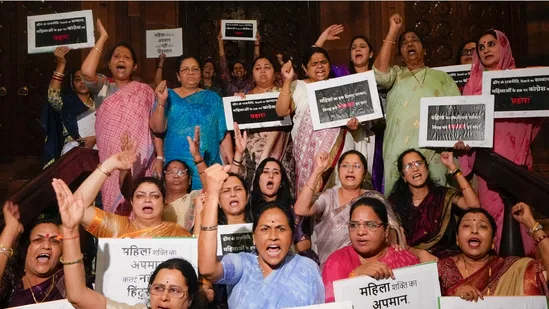
The Bharatiya Janata Party-led government under Narendra Modi suffered a rare legislative setback on Friday as its proposed amendment to the women’s reservation law failed to pass in the Lok Sabha, prompting the withdrawal of two related bills.
The Constitution (131st Amendment) Bill, 2026 — aimed at advancing the implementation of the 2023 women’s quota law — fell short of the required two-thirds majority. The bill secured 298 votes in favour and 230 against, missing the 352-mark needed for passage by 54 votes. This marks the first defeat of a government bill in the Lok Sabha since the NDA came to power in 2014, and the first time since 2011 that a constitutional amendment has failed in the House.
Following the setback, Parliamentary Affairs Minister Kiren Rijiju announced that the government would not proceed with the two accompanying legislations — the Delimitation Bill, 2026 and the Union Territories Laws (Amendment) Bill, 2026. He stated that all three proposals were “intrinsically interrelated,” making it impractical to move ahead with the remaining bills independently.
The now-defeated amendment sought to operationalise 33% reservation for women in the Lok Sabha and state assemblies by 2029 through a delimitation exercise based on the 2011 Census. Under the original 2023 law, the quota is tied to the first census conducted after its enactment — a timeline that could delay implementation until at least 2034.
The proposal to use older census data for delimitation triggered strong opposition concerns over regional imbalance and caste representation. Leader of the Opposition Rahul Gandhi argued that the bill was less about women’s representation and more about redrawing India’s electoral map. He reiterated that the Opposition fully supports women’s reservation if implemented under the framework of the 2023 law.
Echoing similar concerns, Congress leader Priyanka Gandhi Vadra criticised the linkage between women’s reservation and delimitation based on outdated census data, particularly one that does not account for Other Backward Classes (OBCs). She termed the bill’s defeat a “win for democracy.”
The debate also unfolded against the backdrop of the upcoming national census, which, for the first time since 1931, is set to include a caste-based enumeration covering OBCs alongside Scheduled Castes and Scheduled Tribes — a move expected to significantly influence future policy and political calculations.