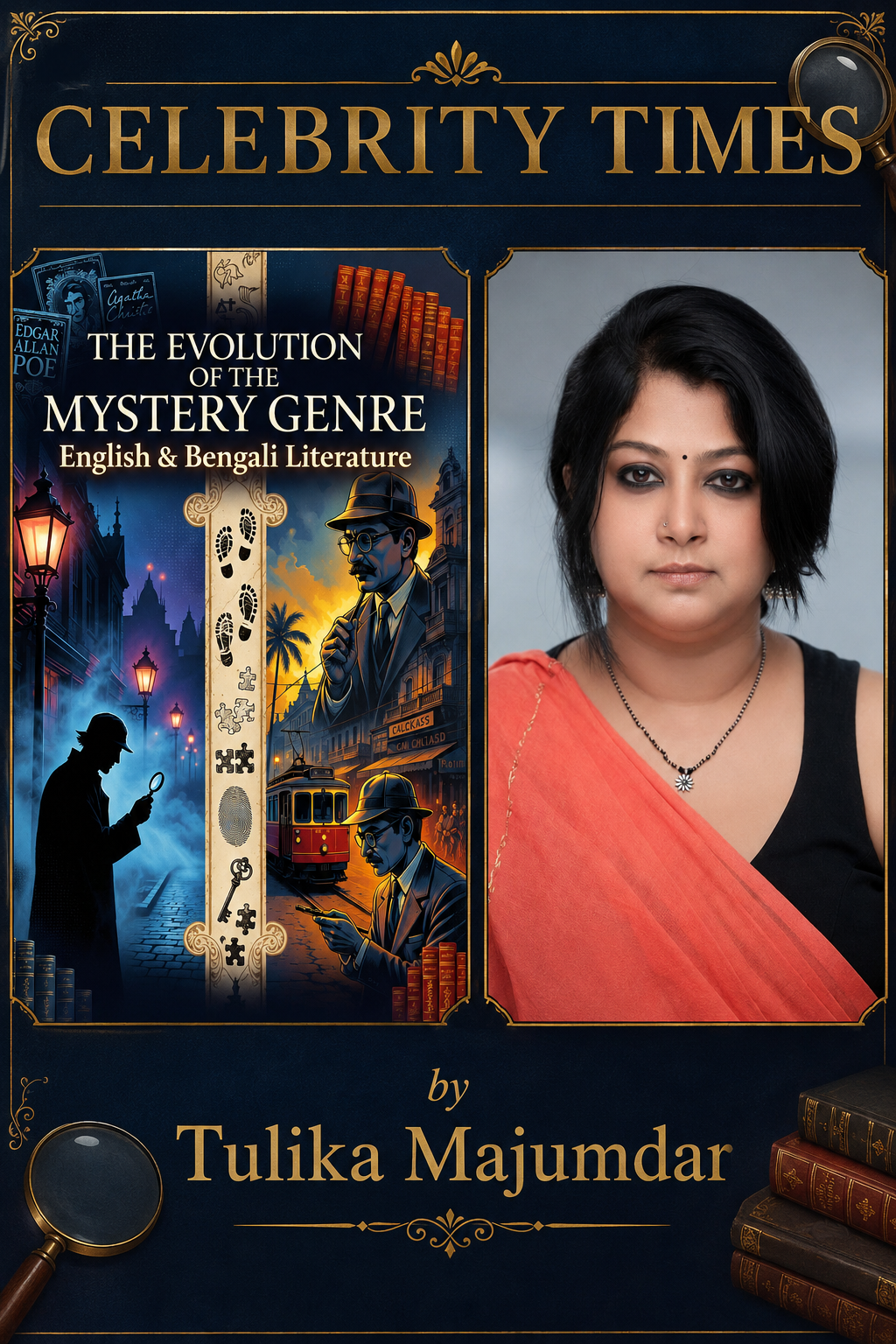
The mystery genre—encompassing detective fiction, crime stories, and suspense narratives built around puzzles, investigations, and revelations—has developed along distinct yet interconnected paths in English and Bengali literature. Shaped by cultural, historical, and social contexts, both traditions share 19th-century Western roots but have evolved with unique flavours and emphases.
Development in English Literature :
The modern mystery genre in English emerged prominently in the 19th century, coinciding with rising literacy, rapid urbanization, the Industrial Revolution, and the establishment of organized police forces such as Scotland Yard in 1842.
Early roots trace back to Gothic novels like Ann Radcliffe’s The Mysteries of Udolpho (1794), which excelled in atmospheric suspense and hidden secrets, and Voltaire’s Zadig (1747), featuring analytical problem-solving. Some scholars find faint precedents in ancient tales and stories from the Arabian Nights.
The true birth of the modern detective story is credited to Edgar Allan Poe. His 1841 tale “The Murders in the Rue Morgue” introduced the brilliant amateur detective C. Auguste Dupin, who solves an apparently impossible crime through rigorous logical deduction, a method Poe termed “ratiocination.”
In the mid-19th century, French writer Émile Gaboriau advanced police procedurals, while English literature gained momentum with Wilkie Collins. His novels The Woman in White (1860) and especially The Moonstone (1868)—often called the first full-length detective novel—masterfully wove together theft, multiple suspects, red herrings, and investigative techniques.
The late 19th century produced the genre’s most enduring icon: Arthur Conan Doyle’s Sherlock Holmes, who debuted in A Study in Scarlet (1887). Holmes became the archetype of the genius detective—eccentric, brilliantly deductive, and accompanied by his loyal chronicler Dr. Watson—popularizing the genre worldwide.
The *Golden Age* (roughly 1920s–1940s) brought a boom in “cozy” or classic whodunits. These stories typically unfolded in isolated country houses, emphasized fair-play clues, intellectual puzzles, and the restoration of social order with minimal graphic violence. Agatha Christie, with Hercule Poirot and Miss Marple (beginning with The Mysterious Affair at Styles in 1920), Dorothy L. Sayers, and others dominated this era.
Post-World War II, the genre diversified dramatically into hard-boiled noir (influenced by American writers like Raymond Chandler), psychological thrillers, police procedurals, historical mysteries, and global variations. Today, mystery remains one of the most popular genres across books, films, and television. English-language mysteries often reflect Enlightenment ideals: faith in logic, individualism, and the ultimate triumph of reason over chaos.
Development in Bengali Literature (Bangla):
Bengali mystery fiction (goyenda kahini or rohosyo kahini) arrived later, during British colonial rule, heavily influenced by English and Western models. It quickly adapted to local realities, blending deduction with adventure, social commentary, humour, and distinctly Bengali sensibilities.
Late 19th-century origins came through translations of Poe, Collins, and Conan Doyle, alongside semi-factual accounts by real police officers. Priyanath Mukhopadhyay’s Darogar Daptar (Detective’s Diary, serialized from around 1892–93) was groundbreaking—real-life-inspired crime cases that introduced suspense and methodical investigation to Bengali readers. Similar narratives by writers like Girish Chandra Bose helped establish the form, reflecting colonial-era policing and urban crime in Calcutta.
In the early 20th century, fully fictional detectives emerged. Inspired by Holmes, authors created detective-assistant duos. Hemendra Kumar Roy’s Jayanta-Manik series was an early landmark.
The Golden Period (1930s–1970s) produced Bengal’s most beloved and enduring detectives, rooting Western-style deduction in Indian and Bengali contexts—Kolkata streets, rural Bengal, family intrigues, and post-colonial realities:
– Sharadindu Bandyopadhyay’s Byomkesh Bakshi (debuting in “Pother Kanta,” 1932) remains the quintessential “Satyanweshi” (truth-seeker)—a thoughtful, philosophical investigator who unravels intricate crimes with quiet intellect.
– Satyajit Ray’s Feluda (Pradosh Chandra Mitter, first appearing in “Feludar Goendagiri,” 1965) is an adventurous, sharp-witted detective aimed primarily at younger readers yet cherished by all ages. The stories combine clever clues with travel, history, and gentle humour.
– Other icons include Nihar Ranjan Gupta’s Kiriti Roy, Sunil Gangopadhyay’s Kakababu, and later female detectives such as Suchitra Bhattacharya’s Mitin Mashi.
In the modern era, the genre continues to thrive through writers like Humayun Ahmed, Aniruddha Bose, and others who incorporate psychological depth, technology, and contemporary social issues. Serialized stories, films, and TV adaptations keep Bengali mysteries immensely popular.
Bengali mysteries often feel more narrative and adventurous than their English counterparts, weaving in local customs, Partition trauma, urban-rural contrasts, and wry humour alongside pure deduction.
Shared Roots, Distinct Flavours:
Both traditions originated from 19th-century Western influences, with English literature pioneering the analytical detective form. Bengali writers localized and enriched the genre, creating characters and stories deeply rooted in regional identity. The result is two vibrant streams of mystery fiction: one celebrated for intellectual puzzles and rational order, the other for its warm, culturally resonant storytelling and enduring iconic sleuths.
Whether it’s Sherlock Holmes in foggy London or Feluda navigating the alleys of Kolkata, the mystery genre continues to captivate by promising that, however tangled the crime, truth and justice can ultimately prevail.