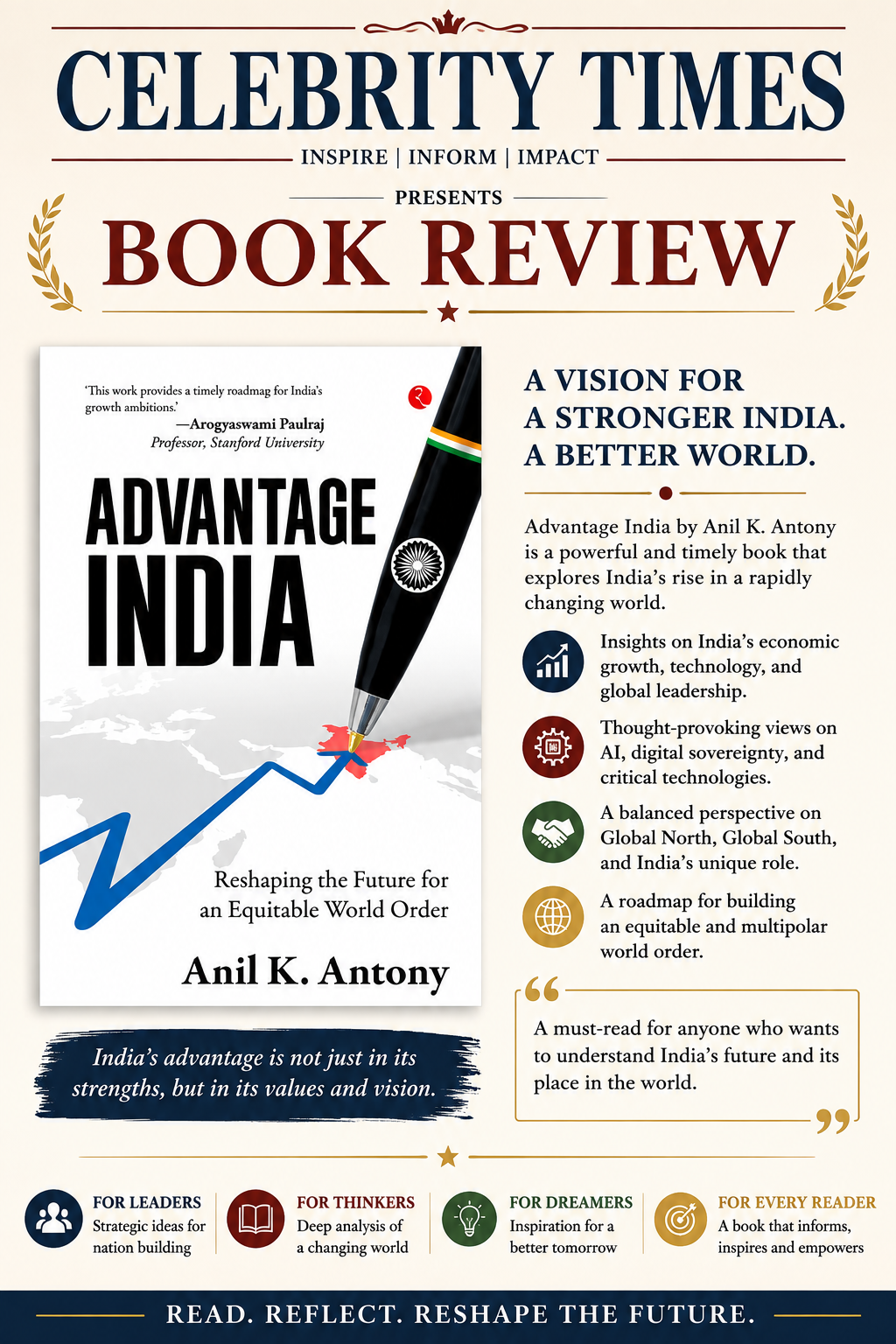
Advantage India: Reshaping the Future for an Equitable World Order by Anil K. Antony is a thoughtful and timely book about India’s changing position in the world. The book looks at how India can grow stronger economically, technologically and strategically while also contributing to a fairer global system.
The author discusses India’s journey from an emerging economy to a country with increasing global influence. He explains how India’s large population, growing economy, technology sector and young workforce can become important strengths in the coming decades.
One of the important topics in the book is technology and artificial intelligence. The author explains why data, computing power, semiconductors and digital infrastructure are becoming important strategic resources. He also discusses India’s need to build its own technological capabilities so that the country does not become too dependent on other nations.
The book also talks about Big Tech and digital sovereignty. It raises important questions about the growing power of large technology companies and their influence over data, communication and public life. The discussion shows why India needs strong digital systems, responsible regulation and home-grown technology platforms.
Another major theme is India’s economic and industrial growth. The author discusses semiconductors, critical minerals, manufacturing and supply chains. These areas are important for India to become more self-reliant and competitive in the global economy.
The book also looks at India’s relationship with the Global North and the Global South. Rather than presenting India as a country that must choose one side, the author presents India as a potential bridge between different parts of the world. India’s role, according to the book, can be based on cooperation, dialogue and shared development.
The historical sections of the book add further context. They explain how the post-World War II global institutions were created and why the existing international system is now facing new challenges. The author argues that the world is moving towards a more multipolar order, where countries such as India will have a greater role.
What makes the book interesting is that it does not focus only on India’s achievements. It also discusses the challenges India must overcome, including technological dependence, economic inequality, infrastructure needs, trade pressures and the need for stronger institutions.
Overall, Advantage India presents an optimistic but realistic vision of India’s future. It encourages readers to think about what India needs to do today to become a stronger and more influential country by 2047.
The book will be especially interesting for readers who want to understand India’s future, global politics, technology, economic growth and the changing world order. Written with a broad strategic perspective, it offers a simple but important message: India’s future strength will depend not only on economic growth, but also on its ability to build technology, institutions and partnerships that create a more balanced and equitable world.