
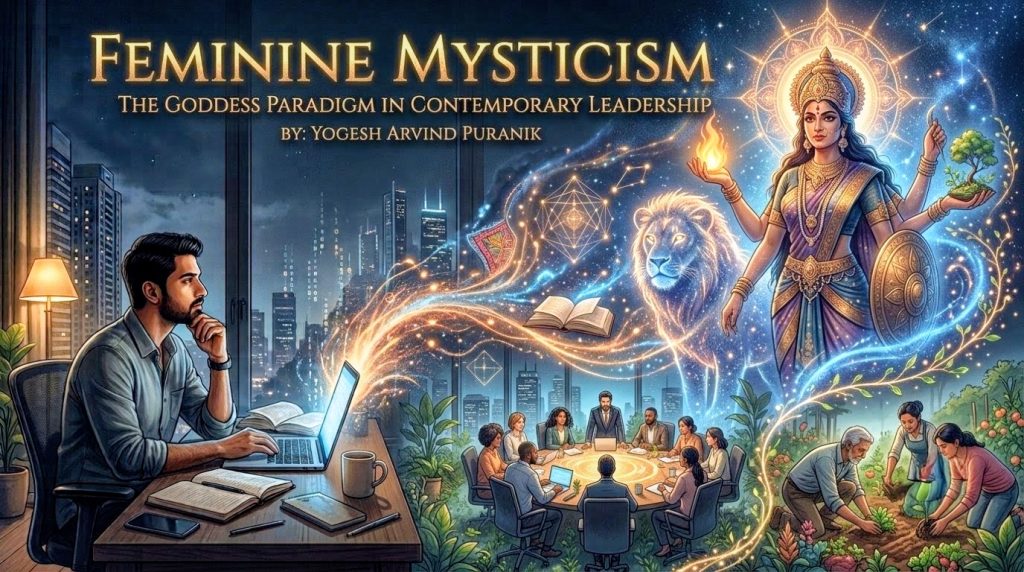
For centuries, our idea of leadership has been shaped largely by a single template, drawn from the language of conquest: dominate the market, capture the audience, command from the top of a rigid hierarchy. That template built formidable institutions, and it would be unfair to deny it. But as the world accelerates, ecological fragility, technological disruption, and widespread burnout are exposing its limits. It is no longer enough to dominate. We must learn to sustain.
In answer, an ancient image is returning to the conversation about power: the Goddess.
She is easily misunderstood. Corporate culture tends to shrink the “Divine Feminine” into mere softness, a synonym for passive nurturing or polite empathy. The old traditions say otherwise. Athena is the goddess of wisdom and also of strategic war. Sekhmet, the lioness-headed deity of Egypt, was feared as a destroyer and invoked as a healer. Durga rides into battle against a demon that no one else can defeat. Kali, in the Shakta traditions, destroys ignorance and ego so that something truer can live. These figures are protective, intuitive, and formidable. They hold the necessary capacity to destroy what is corrupt in order to make room for what can last. (For millions of people, these are living deities, not metaphors, and they deserve to be invoked with that respect.)
To bring this vision into politics, education, or the boardroom, we must change how we measure intelligence and wield power. Three shifts matter most.
The first is to give intuition a place beside evidence. The conventional model treats data as the final authority. The Goddess paradigm sees data as the map and intuition as the compass. In a world where crises arrive faster than data can be gathered, leaders must sometimes decide before the evidence is complete. Intuition is not a mood, though. Daniel Kahneman and Gary Klein, who disagreed on much, agreed that intuition can be trusted where a person has years of practice in a setting that gives honest feedback. A seasoned nurse’s hunch is such a thing. A confident guess is not. The wisdom the Goddess embodies is trained judgment, joined to emotional intelligence and strategic foresight.
The second is to cultivate an ecosystem rather than enforce a hierarchy. A leader in this tradition does not extract the maximum from people for short-term gain. She acts as a gardener, knowing that an organization’s long-term health depends on the psychological and creative well-being of those within it. The evidence points the same way. Google’s Project Aristotle found that psychological safety, the confidence that one can speak up without being punished, was the strongest marker of effective teams. In a widely cited 2010 study in Science, Anita Woolley and colleagues found that a group’s collective intelligence was tied less to the brilliance of its best member than to how well members listened to and took turns with one another. A leader who builds such conditions is not being gentle. She is being effective.
The third is to practice fierce compassion. The Goddess protects, and protection sometimes means saying no, removing a corrupt colleague, or defending the vulnerable against the powerful. Compassion without courage is sentiment. Courage without compassion is cruelty. The mythic figures hold both.
Here the myths also offer a warning. In a well-known story, Kali’s dance of destruction grows so frenzied that it threatens the world, and it ends only when she realizes whom she is trampling. Power of any kind, feminine or otherwise, needs restraint, accountability, and a way of being checked. A paradigm that forgets this becomes a cult of personality with better poetry.
This is why the paradigm must not be tied to gender. A large body of research, including a meta-analysis by Alice Eagly and her colleagues, finds that women on average lean slightly toward collaborative, transformational styles. But the differences are small, and the overlap between men and women is vast. To say that women lead this way and men lead another way is to build a new stereotype. Women in leadership already face a narrow path, expected to be warm yet decisive and punished for seeming either too soft or too hard. If the Goddess becomes one more expectation laid on women, we will have missed the point. The qualities are human qualities, available to anyone willing to cultivate them, and long suppressed in all of us by a culture that equated strength with hardness.
There is, finally, a mystical dimension in the title that deserves its due. Mysticism, at its core, is the sense that we belong to something larger than ourselves. A leader who feels this will govern differently. She will think in generations and not in quarters, and she will see her authority as a trust rather than a trophy. This may be the deepest meaning of the Goddess in leadership: not a style, but a stance of service.
The future will not belong to the conquerors. It will belong to the integrators, those who can combine the fierce and the nurturing, the evidence and the intuition, the strategy and the conscience. The world, wounded and impatient, is waiting for them.