Odisha is a land that has learned to preserve its memory in many forms. It stands in the weathered stones of Konark, in the rituals that gather generations at Puri, in the intricate patterns of its handlooms, and in the stories passed from one generation to the next. Yet, beyond its temples and monuments, there is another inheritance, less visible but no less enduring. It lives in the hands that save seeds, tie threads, paint mythologies, sustain households, and find new possibilities in circumstances that often offer very little.
Much of this work has been carried forward by women.
Their contributions do not always announce themselves through grand monuments or celebrated institutions. They are often woven into the ordinary rhythms of life, repeated over years until the extraordinary begins to look commonplace. A seed preserved for another season, a traditional pattern recreated on a loom, a group of village women managing a common enterprise, a young girl discovering that the world may hold a place for her beyond the boundaries she has inherited: each is an act of continuity, but also of change.
To understand the living heritage of Odisha, perhaps we must look beyond what the state has preserved from its past and towards the women who continue to give that past a future.
The Memory Held in a Seed
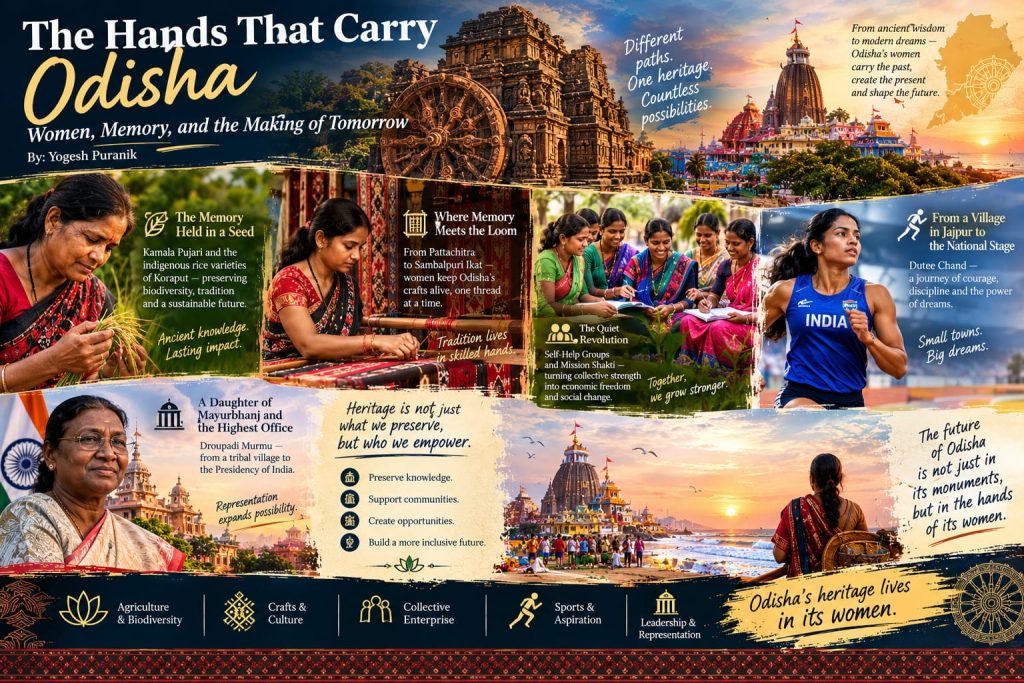
In the tribal landscapes of Koraput, where agriculture has long been shaped by local knowledge and the rhythms of the seasons, the late Padma Shri Kamala Pujari devoted much of her life to preserving indigenous varieties of paddy. Belonging to the Paroja tribal community, she became widely recognised for conserving more than a hundred traditional rice varieties and for promoting organic farming practices among fellow farmers.
Her work was rooted in an understanding that modernity sometimes overlooks. A seed is not merely the beginning of a crop. It carries within it generations of observation, adaptation, and experience. Its value cannot always be measured by the yield of a single harvest. Some varieties endure because they have been suited to particular soils, climates, tastes, or ways of life. To preserve them is to protect possibilities that may become important long after the person who saved them is gone.
Kamala Pujari’s achievement was significant precisely because it challenged the narrow boundaries through which knowledge is often recognised. Scientific understanding does not always emerge from a laboratory, nor does expertise necessarily announce itself through formal qualifications. It can also grow through years of close attention to the land, through inherited practices tested by experience, and through the patient work of preserving what others might dismiss as old-fashioned.
There is something quietly profound about this kind of knowledge. It does not seek to conquer nature so much as to understand its patterns and work within them. It asks for patience in a world increasingly impatient for results.
Pujari’s life reminds us that heritage is not simply a collection of objects we protect because they belonged to our ancestors. It is also a body of knowledge that must remain useful to the living. A seed bank, in this sense, is more than a repository of agricultural diversity. It is an expression of faith in the future, an acknowledgement that those who come after us may need what we have chosen not to discard.
When we speak of preserving Odisha’s heritage, we often think of stone temples and ancient manuscripts. Perhaps we should also think of the women who have preserved the conditions under which future generations can continue to live, cultivate, and remember.
Where Memory Meets the Loom
From the fields of Koraput, the thread of this inheritance leads us towards Odisha’s villages of traditional craftsmanship, where culture takes shape through colour, pattern, and the disciplined movements of the hand.
In Raghurajpur, near Puri, the walls of houses carry painted narratives, and the tradition of Pattachitra continues through artisans who transform cloth and other prepared surfaces into intricate depictions drawn from mythology, religious traditions, and the cultural imagination of the region. In western Odisha, the looms associated with Sambalpuri textiles produce patterns whose colours and forms have become recognisable far beyond their places of origin.
These crafts are often described as the artistic inheritance of a community. But inheritance is not sustained by admiration alone. It depends upon people who learn the techniques, acquire the patience, prepare the materials, repeat the difficult movements, and make the work possible from one day to the next.
Women are integral to many of these processes, although their contributions vary across communities and crafts. In Sambalpuri Ikat weaving, for instance, women have traditionally undertaken important tasks in preparing yarn, tying sections of thread to create patterns, and handling the threads before and after dyeing. These stages may receive less public attention than the finished fabric, yet the final design depends upon their precision and care.
There is a particular beauty in the way an Ikat pattern comes into being. The design must be anticipated before the cloth is woven. Threads are tied and dyed in carefully planned sections, so that the intended pattern emerges when the yarns are brought together on the loom. What appears on the finished fabric as an effortless arrangement of colour is the result of considerable planning, repetition, and skill.
I find something deeply human in this process. We often recognise the finished work while overlooking the invisible labour that made it possible. We admire the painting without asking who prepared the surface, celebrate the textile without understanding the sequence of tasks behind it, and praise an artistic tradition without considering how many hands have sustained it.
The same tendency appears in our understanding of heritage itself. We preserve the object, photograph the finished work, and celebrate its beauty, but we do not always pay equal attention to the people whose labour keeps the tradition alive.
Nor should we imagine that preserving a craft requires its practitioners to remain untouched by change. Artisans must find buyers, respond to changing tastes, manage costs, and negotiate the demands of markets that do not always reward the time and skill their work requires. For women involved in these traditions, the challenge is often to sustain inherited knowledge while finding ways to make their work economically viable.
This is where preservation becomes an act of adaptation.
A tradition that cannot support the lives of those who practise it risks becoming a performance staged for visitors, detached from the communities that once gave it meaning. The future of Odisha’s crafts depends not only upon admiration for their beauty, but also upon the dignity, opportunities, and fair returns available to the people who create them.
The women who sustain these crafts are not merely keeping the past intact. They are negotiating its place in the present.
The Quiet Revolution of Working Together
The relationship between inheritance and change becomes even more visible in the work of women’s Self-Help Groups across Odisha.
For many women, economic independence has not arrived through a dramatic departure from their communities. It has begun through collective effort within them. A group meets, contributions are pooled, accounts are maintained, loans are considered, and a small enterprise takes shape. What begins as a practical arrangement can gradually alter how women see their own abilities and how others respond to them.
Odisha’s Mission Shakti programme, launched in 2001, has made women’s Self-Help Groups an important part of the state’s approach to economic and social empowerment. Through these groups, women have participated in a wide range of activities, from agricultural and fisheries-related livelihoods to the supply of public services and the marketing of locally produced goods.
Some groups have taken up pisciculture in community ponds. Others have become involved in public distribution, agricultural enterprises, or electricity meter reading and billing. Such work may not attract the attention reserved for celebrated entrepreneurs, but it represents a significant change in the everyday distribution of responsibility and opportunity.
A woman who manages a group’s accounts must learn to make decisions that affect others. A group that negotiates with a supplier or manages a livelihood enterprise must consider costs, risks, and returns. Members must learn to trust one another, resolve disagreements, and accept collective responsibility for outcomes that cannot always be predicted.
These are economic activities, but they are also exercises in public participation.
The importance of this change lies not only in the income women earn, but in the range of decisions they become able to make. Financial independence can alter a household’s choices about education, healthcare, and expenditure. Collective enterprise can give women a greater voice in community affairs. The experience of managing money and responsibility can challenge assumptions about who is qualified to lead.
None of this means that empowerment is complete simply because a group has been formed or an enterprise has begun. Access to markets, reliable credit, training, fair remuneration, and freedom from social constraints remain important. Nor should the language of empowerment obscure the labour women already perform within households and communities, much of which remains unpaid and insufficiently acknowledged.
Yet there is something important in the collective nature of this movement.
For generations, women have contributed to the survival of households and the continuity of local traditions. Self-Help Groups can create opportunities for that work to become more visible, more organised, and more economically rewarding. They can help turn individual effort into collective agency.
Perhaps this is one of the more meaningful ways in which heritage and modernity meet. The traditions of cooperation, mutual dependence, and community responsibility need not disappear as women enter new economic roles. They can become resources through which those roles are imagined and sustained.
The future does not always arrive by replacing the past. Sometimes, it begins when people discover new possibilities within the relationships they already share.
From a Village in Jajpur to the National Stage
The journey from inherited circumstances to new possibilities is also visible in the lives of women who have carried their ambitions beyond the places where they began.
Dutee Chand, born into a weaver’s family in Chaka Gopalpur village in Odisha’s Jajpur district, grew up in circumstances that offered few assurances of an easy future. Her rise as a sprinter brought her to the national and international athletic stage, including the Olympic Games. Her achievements helped establish her as one of India’s prominent track athletes.
Her story is inseparable from the determination required to pursue sport when resources are limited and the path ahead is uncertain. Athletic success demands years of training, discipline, and the willingness to endure setbacks that may never be visible to spectators. For a young woman from a modest family, these demands can be accompanied by additional social and economic pressures.
Chand’s journey reminds us that talent can emerge from places far removed from the centres where opportunity is concentrated. It also reminds us that recognition, however welcome, does not erase the obstacles that precede it.
Her story is particularly meaningful in a state with a rich tradition of weaving. The family background from which she emerged should not be romanticised as though hardship itself creates greatness. Rather, it makes visible the distance a person may have to travel when aspiration exceeds the opportunities immediately available to her.
Sport offered Chand a different arena in which to test her abilities. Her journey expanded the possibilities that others might imagine for themselves, especially girls who have not yet been encouraged to think of their ambitions as legitimate.
There is no single quality that can be said to define the women of Odisha, just as no one person’s life can represent an entire state. Yet individual journeys can challenge the limits of what a society considers possible. They can make an unfamiliar future easier for someone else to imagine.
Sometimes, that is how change begins: not with the disappearance of inherited circumstances, but with a person who finds a way to move beyond them.
A Daughter of Mayurbhanj and the Highest Office
Few journeys illustrate the distance between one’s beginnings and the possibilities of public life more visibly than that of Droupadi Murmu.
Born into a Santhal family in Uparbeda village in Mayurbhanj district, Murmu pursued her education before entering public service. She worked as a junior assistant in the Odisha government and later as a teacher in Rairangpur. Her subsequent political career included service as a legislator and as Governor of Jharkhand. In July 2022, she was sworn in as the fifteenth President of India, becoming the first person from a tribal community and the second woman to hold the office.
Her rise carries significance beyond the distinction of the position itself. It brings a woman from a historically marginalised community into the highest constitutional office of the country, challenging assumptions about who belongs in the institutions through which a nation represents itself.
Yet the importance of her journey should not be reduced to the symbolism of a single achievement. It is also a reminder of the value of education, public participation, and the long, often uncelebrated work through which a person acquires the experience to serve in positions of responsibility.
Murmu’s roots in Mayurbhanj remain an important part of her public story, but they should not be treated as a complete explanation of her achievements. Her education, work, political experience, and personal determination all form part of the journey.
There is, however, something moving in the distance between Uparbeda and Rashtrapati Bhavan. The journey asks us to reconsider the boundaries we place around possibility, particularly for girls growing up in communities where opportunity may be unevenly distributed.
A village should not have to produce an extraordinary individual before its children are considered worthy of opportunity. Education, dignity, and the freedom to pursue one’s abilities should not depend upon the eventual arrival of national recognition.
If Murmu’s life offers a lesson, perhaps it is that representation matters most when it expands the horizon for those who follow. The significance of a woman reaching the highest office should not lie only in the fact that she has arrived, but also in whether other women and girls can now imagine a wider range of futures for themselves.
Her story belongs to the history of modern India, but it also belongs to the evolving story of Odisha, where the experience of women from tribal communities, rural households, and modest economic backgrounds continues to challenge inherited expectations.
The Heritage We Choose to Carry
When we speak of Odisha’s heritage, it is natural to think first of its temples, its sculptural traditions, its sacred geography, and its extraordinary artistic inheritance. These are visible expressions of a civilisation that has continually found ways to give form to memory.
But heritage is not sustained by monuments alone.
It survives when agricultural knowledge is carried from one season to the next. It survives when a craftswoman teaches another pair of hands to recognise the difference between a successful pattern and a failed one. It survives when women organise themselves to manage an enterprise, when a young athlete refuses to abandon her ambitions, and when a girl from a remote village is able to imagine a life in public service.
These acts are not identical, and they should not be forced into a single narrative of progress. Kamala Pujari’s work in agricultural conservation, the labour of women artisans, the collective efforts of Self-Help Groups, Dutee Chand’s athletic career, and Droupadi Murmu’s public life belong to different worlds. Their circumstances and achievements cannot be measured by the same standard.
What connects them is something more fundamental. Each reveals the importance of recognising women not merely as recipients of inherited traditions or beneficiaries of development, but as people who make choices, preserve knowledge, exercise judgement, and create possibilities for others.
Their work also asks something of the society that celebrates them. It asks whether we are prepared to value the labour that remains unseen, support the communities that sustain traditional knowledge, and create opportunities that do not require exceptional determination simply to overcome ordinary barriers.
It is easy to praise the past when it appears in the form of a magnificent temple or a beautifully woven textile. It is more demanding to recognise the people whose daily work allows such traditions to remain part of a living culture. It is easy to celebrate a woman who has reached the highest office in the country. It is more important to ask whether girls in every village have access to the education, encouragement, and freedom that make such possibilities imaginable.
Perhaps the truest measure of a living heritage is not how carefully we preserve its outward forms, but how generously we allow its people to shape what comes next.
Odisha’s women are not simply carrying forward an inheritance that has already been defined for them. They are deciding, through their work and their lives, what deserves to be preserved, what must be changed, and what new possibilities can emerge from the meeting of the two.
A seed saved in Koraput, a pattern emerging from the threads of an Ikat loom, a group of women managing a common enterprise, a sprinter on the track, and a President who began her journey in Mayurbhanj may appear to belong to very different stories.
Perhaps they do.
But together, they remind us that the future of a culture is never secured by memory alone. It depends upon the people who are given the opportunity to carry that memory forward, and the freedom to make something new from it.
The temples of Odisha will continue to stand as witnesses to its past. The more difficult and perhaps more meaningful task is to ensure that the women who sustain its living traditions are recognised not only for what they preserve, but also for everything they have yet to become.