
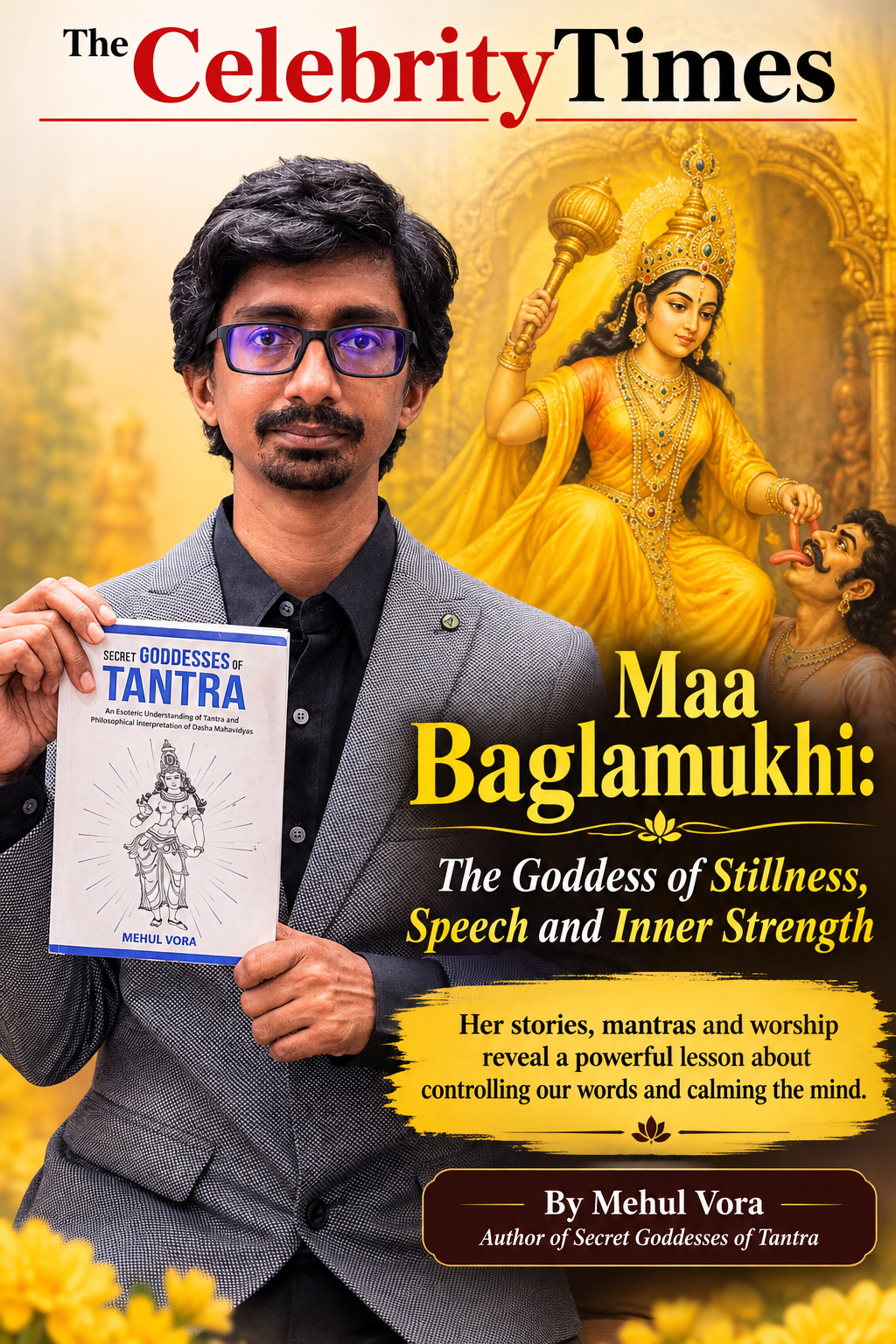
Have you ever said something in anger and regretted it later? Or wished you could stop worrying about something that has not even happened? Sometimes a few careless words can damage a relationship, while a moment of silence can save it.
In the Tantric traditions of India, Maa Baglamukhi represents this power to stop, become still and regain control. She is the eighth of the Dasha Mahavidyas, the ten great wisdom goddesses. Also called Pitambara Devi because of her yellow clothing, she is traditionally worshipped for protection, strength in difficult situations and victory over opposition. Yet her deeper teaching is about mastering our own speech and mind.
Maa Baglamukhi and the Power of Stillness
In my book Secret Goddesses of Tantra, I describe Baglamukhi as the goddess of “ultimate stillness”. Her power is called Stambhana: stopping or holding something in place. A verse given in the book from the Pitambara Stotra, associated with the Rudrayamala Tantra, begins:
Vādi mukati raṅkati kṣiti-patir vaiśvānaraḥ śītati
It describes a skilled speaker becoming silent, a wealthy ruler losing his riches and a fierce fire cooling down. It is a devotional description of a power that can reverse what appears unstoppable.
Even when everything around us is moving, stillness has its place. My book compares Baglamukhi with the idea of inertia: an object stays at rest, or continues moving steadily, until a force changes its state. This is a philosophical comparison, not a scientific explanation of the goddess. Spiritually, she represents the ability to stop confusion, pay attention and act with clarity. She is also described in the book as the commander of Adishakti’s army, the force that stops what threatens balance.
The Stories of Goddess Baglamukhi
The Shakti Samagama Tantra tells of a terrible storm in Satya Yuga that threatened the universe. Lord Vishnu prayed to Adishakti beside the yellow Haridrakhya pond in Saurashtra. The goddess appeared as Baglamukhi, and powerful rays spread from the pond, stopping the storm. This story connects her with the colour yellow and the name Pitambara.
Another story, recorded by scholar David Kinsley and discussed in my book, is about Madan. He had received a boon that whatever he said would become true. When he began using this gift to hurt innocent people, Baglamukhi caught his tongue and stopped his harmful speech. As she was about to kill him, he surrendered and asked for a blessing. The story explains why a demon is shown beside her in many images.
A third account, attributed in the book to the Pranatosini Tantra, tells of Parvati repeatedly asking Shiva for food. Shiva asked her to wait, and in her hunger and frustration she swallowed him. After a while, Shiva came out, while smoke rose from her body. In this particular account, Parvati’s state is connected with Baglamukhi, while the smoke is linked with Dhumavati, another Mahavidya. These are different traditional stories, not one single historical account.
Why Does Maa Baglamukhi Hold a Demon’s Tongue?
Baglamukhi is usually shown with a golden complexion, three eyes, yellow clothes, yellow champa flowers and beautiful ornaments. In her familiar two-armed form, she sits on a decorated throne, holds a demon’s tongue with her left hand and raises a mace with her right. The longer Dhyana Mantra in my book includes this line:
Devīṃ smarāmi dhṛta-mudgara-vairijihvām.
In simple words: I remember the goddess who holds a mace and the tongue of an enemy.
Why the tongue? Because it is used both for speaking and tasting, and it is not easy to control either. We can use speech to pray, encourage and tell the truth. We can also use it to gossip, lie, insult or show off. Baglamukhi holding the tongue is a reminder to stop harmful speech and empty talk before it causes damage.
The Bhagavad Gita (17.15) teaches a similar lesson about how we should speak:
अनुद्वेगकरं वाक्यं सत्यं प्रियहितं च यत्।
Anudvegakaraṃ vākyaṃ satyaṃ priyahitaṃ ca yat.
Our words should be truthful, kind, helpful and not needlessly upsetting. My book also draws a comparison with the Bible: James 3:5 describes how a small tongue can cause great harm, just as a small spark can start a large fire. Across traditions, the message is familiar: think before you speak.
The Crane, the Colour Yellow and the Power of Intelligence
One interpretation connects the name Baglamukhi with bagala, or crane. The crane can stand motionless in water and strike when a fish comes close. In the symbolism discussed in my book, this becomes an image of patience, stillness and acting at the right moment. Another traditional explanation links vagala with control and mukhi with face. These are traditional interpretations of her name rather than a settled linguistic origin.
Yellow is central to her worship: yellow clothes, flowers, sweets and a turmeric-bead mala. The book connects yellow with hope, warmth, knowledge, communication, confidence and clear thinking. It also notes a darker side: intelligence can be confused or misused. Baglamukhi is said to turn speech into silence and silence into speech, knowledge into confusion and confusion into knowledge. In that sense, her power is not simply to stop an opponent; it is also to show how important sound judgement really is.
Traditional descriptions include a two-armed form, called Dakshinamnaya, and a four-armed form, called Urdhvamnaya. Baglamukhi is linked with Stambhana, the power to stop harmful actions, and Vak Siddhi, a traditional spiritual power associated with speech. The same goddess who stops destructive words is also believed to bless meaningful, effective speech.
Baglamukhi Mool Mantra, Beej Mantra and Benefits
The Baglamukhi Mool Mantra printed in Secret Goddesses of Tantra reads, with its Sanskrit spelling regularised for clarity:
ॐ ह्रीं बगलामुखी सर्वदुष्टानां वाचं मुखं पदं स्तम्भय जिह्वां कीलय कीलय बुद्धिं विनाशय ह्रीं ॐ स्वाहा॥
Om Hrīm Baglamukhi Sarva Duṣṭānāṃ Vācaṃ Mukhaṃ Padaṃ Stambhaya, Jihvāṃ Kīlaya Kīlaya, Buddhiṃ Vināśaya, Hrīm Om Svāhā.
The prayer asks the goddess to stop the speech, movement and intelligence used to cause harm. The phrase buddhiṃ vināśaya literally asks for intelligence to be destroyed or disabled; in this setting, it refers to stopping the harmful plans of an enemy. The seed syllable in the version printed in my book is Hrīm (ह्रीं). Other Baglamukhi traditions use Hlīm (ह्लीं), so the two forms should not be confused.
Devotees traditionally associate Baglamukhi mantra chanting with protection, courage, success in debates and help during disputes or legal problems. These are religious beliefs, not promised results. At a deeper level, her worship asks us to become less impulsive and more thoughtful.
Baglamukhi and the Restless Mind
Our mind often creates trouble before anything has happened. We replay arguments, worry about tomorrow or make decisions in anger. Arjuna expresses this struggle in the Bhagavad Gita (6.34):
चञ्चलं हि मनः कृष्ण प्रमाथि बलवद्दृढम्।
तस्याहं निग्रहं मन्ये वायोरिव सुदुष्करम्॥
He tells Krishna that the mind is restless and difficult to control, almost like the wind. In the philosophical reading of Baglamukhi, Stambhana also points towards calming this restless mind.
The Parama Samhita, quoted in my book, encourages careful speech and control of the mind. The chapter also connects stillness with yogic ideas about prana, breath, concentration and meditation. This means steady, guided spiritual practice—not trying to forcefully hold or stop the breath.
Baglamukhi Puja Vidhi, Sadhana and Yantra
In ordinary devotional worship, people offer prayers, yellow flowers, turmeric and yellow sweets. The Baglamukhi Yantra is a sacred design described in my book as having four gates, an eight-petalled lotus, six-pointed geometry formed by two crossing triangles, and a central triangle containing the seed syllable. It may be drawn on bhojpatra or made on a metal plate.
More formal Baglamukhi Puja Vidhi includes meditation, offerings, worship of the Yantra and mantra chanting. The book also describes advanced Baglamukhi Sadhana with strict rituals, fire offerings and practice in secluded places. It discusses Shava Sadhana as part of certain extreme Tantric traditions. These are historical and religious descriptions, not practices for readers to attempt; specialised worship requires a properly trained teacher.
Devotees may also use Baglamukhi Stotram and Baglamukhi Kavach as traditional prayers of praise and protection. Baglamukhi Jayanti is observed as an occasion for special worship. These topics are mentioned here for context; the book’s Baglamukhi chapter does not provide a complete text of the Kavach or a detailed Jayanti calendar.
Important Maa Baglamukhi Temples in India
The book discusses Shri Pitambara Peeth at Datia in Madhya Pradesh; Bankhandi Baglamukhi Temple and the Kotla shrine in Himachal Pradesh; and the Nalkheda Baglamukhi Temple in Agar Malwa district of Madhya Pradesh, on the Lakhundar River. At Nalkheda, the goddess is worshipped with Lakshmi and Saraswati, giving rise to the name Trishakti Mata. Traditional accounts connect some of these temples with the Pandavas; these should be understood as local religious traditions.
The chapter also notes Somalapura Siddha Peeth in Karnataka and a Baglamukhi shrine connected with the Virupakshi temple complex near Kolar. Devotees visit these places to seek blessings, guidance and strength during difficult times.
The Real Meaning of Maa Baglamukhi Today
We spend so much energy trying to control people and situations around us. But how often do we try to control our own thoughts, emotions and words? Not every argument needs an answer. Not every insult deserves a reaction. Sometimes, staying calm takes more strength than speaking loudly.
Baglamukhi holding the demon’s tongue reminds us to think before we speak. Her mace shows the strength needed to stop harmful behaviour. Her yellow appearance reminds us to use intelligence wisely. And her stillness invites us to find peace within ourselves.
Perhaps the greatest blessing of Maa Baglamukhi is not the power to defeat our enemies, but the wisdom to stop becoming our own enemy.
About the author
Mehul Vora is an Indian author. His book Secret Goddesses of Tantra: An Esoteric Understanding of Tantra and Philosophical Interpretation of Dasha Mahavidyas explores the stories, symbolism, philosophy and worship traditions of the ten Mahavidyas.
Source: Adapted from Chapter 16, “Bagalāmukhī — Ultimate Stillness,” pp. 303–315 of Secret Goddesses of Tantra by Mehul Vora. Sanskrit quotations from Bhagavad Gita 17.15 and 6.34 are included for explanation.
Her stories, mantras and worship reveal a powerful lesson about controlling our words and calming the mind.
By Mehul Vora | Author of Secret Goddesses of Tantra