
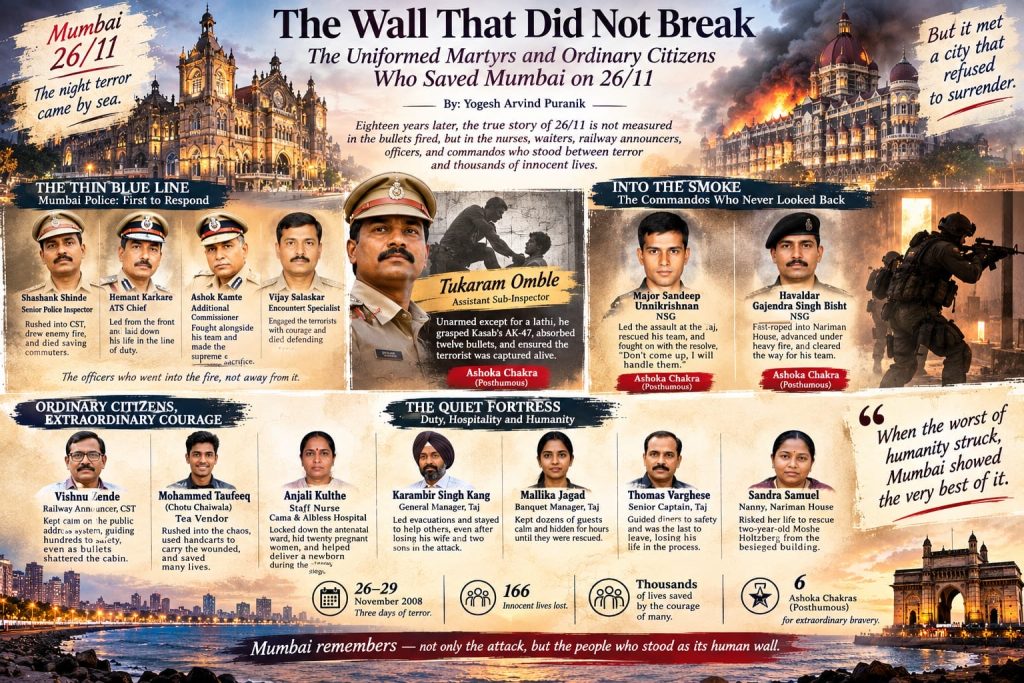
Written by Yogesh Arvind Puranik
Eighteen years after ten gunmen laid siege to Mumbai, the true story of those sixty hours is not measured in the bullets fired, but in the nurses, waiters, railway announcers, officers, and commandos who stood between terror and thousands of innocent lives.
On the warm evening of November 26, 2008, Mumbai moved to its familiar, restless rhythm. Commuters hurried beneath the vaulted stone arches of Chhatrapati Shivaji Terminus, laughter spilled onto the pavement outside Leopold Café, and families lingered over dinner beneath the chandeliers of the Taj Mahal Palace and the Oberoi Trident. Within minutes, that ordinary Wednesday night tore open into sixty hours of fire, sirens, and grief.
Ten heavily armed terrorists had crossed the Arabian Sea with a cold-blooded objective: to slaughter as many civilians as possible and bring India’s financial capital to its knees on live television. By the time the siege ended, 166 innocent people had been killed. Yet the death toll was engineered to be exponentially worse.
That thousands of train passengers, hotel guests, expectant mothers, and bystanders walked away alive owes everything to an extraordinary human wall—built not only by police officers and elite commandos, but by ordinary men and women in aprons, hospital scrubs, and railway booths who refused to run when running was the only logical choice.
The Thin Blue Line: Holding the Streets
Long before elite reinforcements could fly in from Delhi, Mumbai Police stood almost alone against military-grade assault rifles and hand grenades.
At Chhatrapati Shivaji Terminus (CST), Senior Police Inspector Shashank Shinde rushed straight into the concourse as gunmen mowed down fleeing travelers. Armed only with a service revolver against automatic weapons, he drew their fire to buy commuters precious seconds to scatter, falling on the platform he died defending.
Across South Mumbai, three of the city’s most seasoned officers—Anti-Terrorism Squad Chief Hemant Karkare, Additional Commissioner Ashok Kamte, and Encounter Specialist Inspector Vijay Salaskar—refused to command from the safety of a control room. Learning that terrorists had entered the vicinity of Cama and Albless Hospital, they drove into the dark lane beside the hospital to cut off the killers’ path. Ambush erupted in the shadows. All three officers fought back until their final breath, sacrificing their lives in the line of duty and earning the Ashoka Chakra posthumously.
Hours later, past midnight, the turning point of the entire siege unfolded at a makeshift barricade near Girgaon Chowpatty. A hijacked silver Skoda carrying two terrorists screeched to a halt under the glare of police headlights. The driver, Abu Ismail, was killed in the ensuing exchange of fire. Slumped in the passenger seat, Ajmal Kasab pretended to be dead to lure the officers close.
Assistant Sub-Inspector Tukaram Omble—a 54-year-old former soldier known quietly for his steadiness—carried no rifle and wore no bulletproof vest. Armed with little more than a wooden lathi, he stepped forward to disarm the man inside. The instant Omble reached the open door, Kasab sprang up and squeezed the trigger of his AK-47.
Omble did not drop to the asphalt. Instead, he planted himself directly in front of the muzzle, clamped both hands around the scorching barrel, and locked it downward against his own chest. Twelve bullets tore through his body as Kasab thrashed to wrench the rifle loose. Omble’s grip never broke. Using himself as a living shield, he absorbed every round so not a single bullet could strike the fellow officers standing behind him.
Moments later, his teammates surged in and pinned Kasab down alive. Posthumously awarded the Ashoka Chakra, Tukaram Omble did more than save his squad—by delivering the sole surviving attacker into custody, his sacrifice exposed the entire cross-border conspiracy behind 26/11 to the world.
Into the Smoke: The Commandos Who Never Looked Back
Less than three kilometers away, flames roared out of the iconic red dome of the Taj Mahal Palace Hotel. Inside, the century-old building had become a pitch-black labyrinth of choking smoke, shattered chandeliers, and hidden traps, with hundreds of terrified guests locked inside their rooms.
First into the inferno before dawn were the Navy’s MARCOS (Marine Commandos), who navigated zero-visibility hallways without floor plans to pin the gunmen down and evacuate stranded guests. Soon after, the National Security Guard’s 51 Special Action Group launched Operation Black Tornado.
Leading his squad through the Taj was 31-year-old Major Sandeep Unnikrishnan. Room by room, floor by floor, his men engaged terrorists who held the upper floors and fired blindly down stairwells. When one of Major Sandeep’s comrades was hit during a fierce firefight, Sandeep immediately exposed himself to enemy fire to arrange the wounded commando’s safe evacuation.
Seeing the gunmen attempt to slip upward to the next floor—closer to trapped civilians—Major Sandeep made a split-second choice. He pursued them alone. As his team moved to follow him up the stairs, his final command cut through the chaos. According to NSG officials, his last words were: “Don’t come up, I will handle them.”
Fighting single-handedly against four heavily armed killers, Major Sandeep relentlessly drove them back and cornered all four in the Ballroom at the northern end of the Taj before taking fatal fire. His sacrifice boxed them in completely; NSG commandos subsequently neutralized all four terrorists trapped between the Ballroom and the Wasabi restaurant. Major Sandeep Unnikrishnan, too, was honored posthumously with the Ashoka Chakra.
Simultaneously, at Nariman House—a Jewish community center held hostage in Colaba—NSG commando Havaldar Gajendra Singh Bisht fast-roped from a hovering helicopter onto a roof swept by bullets and grenade shrapnel. Facing fierce resistance at the entrance, he kept advancing under fire to clear the threshold for his squad, taking mortal wounds so his team could breach the building and eliminate the attackers. He became the sixth 26/11 martyr awarded the Ashoka Chakra.
Voices in the Chaos: Heroes of the Station and the Wards
Yet the shield that protected Mumbai was never made of Kevlar alone. Some of the night’s most decisive victories were won by citizens who possessed no weapons at all.
High above the blood-stained concourse of CST sat railway announcer Vishnu Zende inside a glass-walled cabin. When gunfire erupted below and panic drove commuters blindly toward the very exits where the terrorists stood, Zende could have bolted out the back. Instead, he pulled the microphone close. Speaking calmly into the public address system, he guided hundreds of disoriented passengers away from the gunmen and out through the rear gates. Even when a terrorist noticed his voice and fired at the cabin—shattering the glass near him—Zende ducked, kept his hand on the switch, and stayed on the air until the platforms emptied.
Down on the street outside CST, a young tea vendor named Mohammed Taufeeq—known to commuters simply as Chotu Chaiwala—ran straight toward the screams. While the station still echoed with gunfire, Taufeeq grabbed handcarts and began loading bleeding strangers onto them, wheeling the wounded to ambulances and rushing dozens of victims to St. George Hospital.
Barely a short walk away stood Cama and Albless Hospital, a sanctuary for women and children. When terrorists stormed the compound and shot two unarmed hospital guards who had tried to raise an alarm, staff nurse Anjali Kulthe was on night duty in the antenatal ward. Hearing the blasts outside, she wasted not a second. She slammed shut the heavy doors of the ward, switched off every light, and ushered twenty pregnant women into a small, darkened pantry. Pressing her finger to her lips to steady their breathing, she kept them hidden and silent as footsteps echoed outside—and even went on to assist in delivering a newborn baby while the city burned beyond the windows.
The Quiet Fortress: Duty Above Survival
Inside the besieged hotels and Nariman House, hospitality and love hardened into astonishing courage.
At the Taj Mahal Palace, General Manager Karambir Singh Kang stood on the ground floor directing evacuations as smoke billowed from the upper levels. High above, on the sixth floor, his wife Neeti and their two young sons, Uday and Samar, were trapped in the spreading fire. Even as the unthinkable unfolded and his entire family perished in the flames, Kang refused to abandon his post. Hollowed by unimaginable grief, he remained at the hotel through the siege, ensuring hundreds of guests and junior staff made it out alive.
Beside him stood employees half his age who displayed the same fierce grace. Mallika Jagad, a 24-year-old banquet manager, found herself responsible for dozens of trapped guests locked inside a dining room as gunshots rattled the corridor outside. She ordered the lights killed, phones silenced, and chairs moved away from the doors, calmly holding the room together through hours of terror until Mumbai’s firefighters—scaling precarious ladders into the smoke under active gunfire—pulled everyone to safety.
Down inside the hotel’s Wasabi restaurant, Senior Captain Thomas Varghese calmly led diners toward a narrow back staircase, telling them to crouch and move quickly. He stood by the exit until every single guest had slipped away, insisting on being the last to leave. He never made it out; the gunmen found him in the corridor he had kept clear for strangers.
And inside the shattered walls of Nariman House, where Rabbi Gavriel Holtzberg and his wife Rivka had been killed, an Indian nanny named Sandra Samuel listened from hiding through a night of terror. In the silence of the following morning, she heard a sound that broke through her fear: the crying of two-year-old Moshe Holtzberg. Stepping out from cover into a room still prowled by killers, Samuel ran straight to the weeping toddler, scooped him into her arms, and sprinted out of the building into daylight, saving the child’s life.
Eighteen years on, local trains thunder once more through Chhatrapati Shivaji Terminus, nurses walk the bright wards of Cama Hospital, and the sandstone arches of the Taj glow warm against the evening tide of the Arabian Sea. To a stranger strolling down Marine Drive, the concrete scars of 26/11 have vanished.
Yet Mumbai remembers—not merely the darkness that arrived by boat, but the luminous, stubborn humanity that met it on the shore. Whether it was Tukaram Omble’s unyielding hands, Major Sandeep Unnikrishnan’s final order, Vishnu Zende’s steady voice over a loudspeaker, or a nurse holding twenty mothers quiet in the dark, they proved something terror can never comprehend: when the worst of humanity strikes, the very best of it steps forward to take the blow.