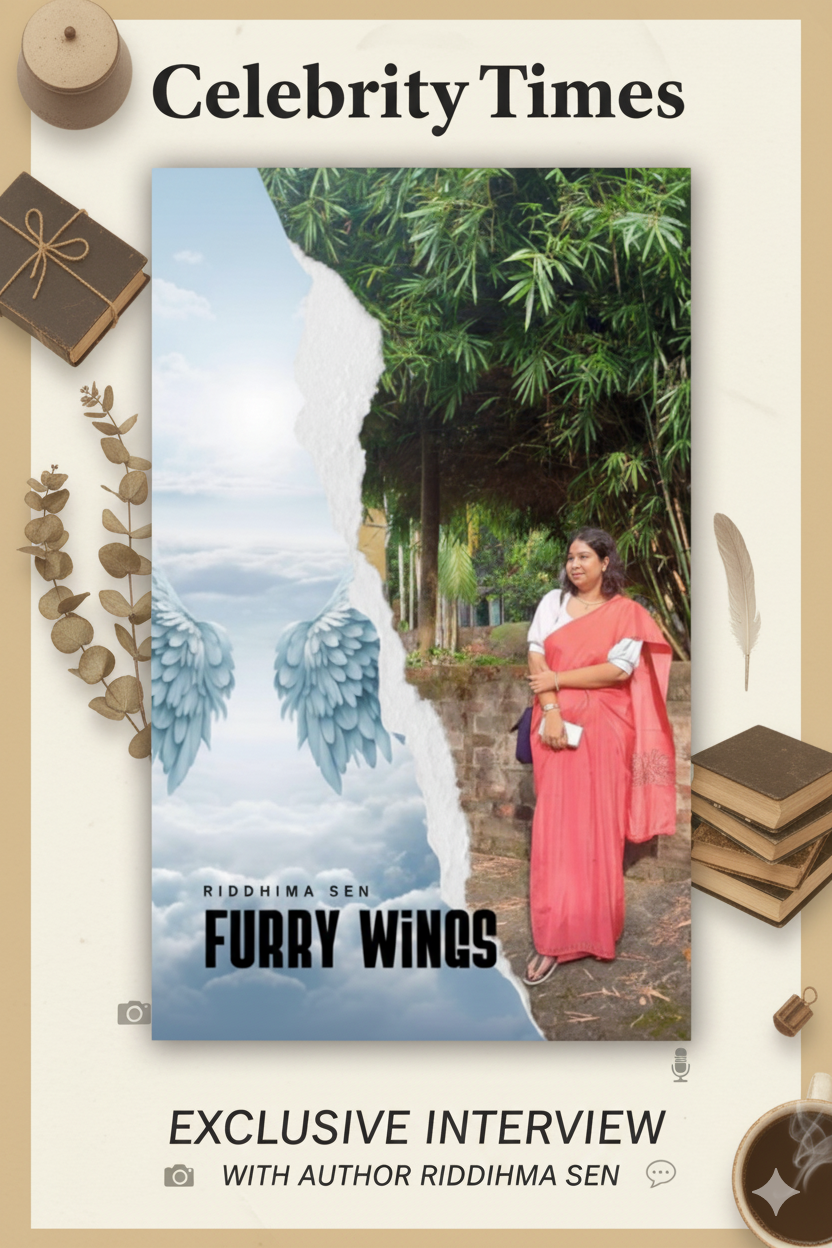
Furry wings is a unique title. Describe what the book is about and what inspired the story behind these unusual, magical wings?
So the story is derived from a personal experience of losing a pet who was very close to my heart. As you can already understand, “furry” refers to a furry animal—like a dog or a cat. In this scenario, it was a dog. What happened was that last year, my pet died abruptly. It was so sudden that we didn’t expect it at all, and it was quite a shock for me.
The idea behind writing the book was to commemorate her memory and also to deal with the sorrow of losing her so unexpectedly. When you lose someone close to you, the shock is overwhelming. Many people cope by emotionally toughening themselves or becoming a bit aloof from everything happening around them. My way of dealing with grief, however, is writing—it helps me express and release my emotions. So I thought, why not write about it? It would serve as a homage to her and also become a story that talks about the love between humans and animals, something we truly need nowadays with everything happening around us.
She was a female puppy, very young—around 3 years old, though I don’t remember the exact age right now. She was just a baby. She was suffering from distemper, and eventually, she passed away.
What first sparked the idea for Furry Wings, and when did you realize it needed to become a full book?
This comes from another personal story. I was writing a book about the bond between a human and a human’s pet a long time back, and I had written the manuscript and sent it for approval. It wasn’t approved, so that was a personal career setback for me. When it was not published and when the incident happened a year back, I thought this could be a good opportunity to, you know, work on the thing again and come up with a book if possible.
Was there a particular moment, experience, or emotion in your life that motivated you to write this story?
So the basic idea is that, as I have already mentioned, it’s to pay homage to my pet and all of that. Besides that, the moment which inspired me to write the book is the fact that we often believe in the idea of holding on to people and pets, and when they leave us. This idea of holding on is very painful in itself because it leaves you with a lot of scars, and you can’t live a normal life. It’s very hard to live normally when you are holding on to it and thinking about it every single day. Obviously, the thoughts will come to your mind, but it shouldn’t be regular, you know, because that’s how it affects your psyche.
So, the motive was basically to become an inspiration for people who have lost someone precious to them and to show them that you can actually remember them for the good times and not just for the fact that they are not here with you. So, that life still feels beautiful despite how untouchable or difficult it becomes. Life is beautiful, no matter how many times death comes and goes. I mean, yes, life is pretty unpredictable. But once again, that’s how life is—you can’t expect it to be like a railway track running straight and parallel. It’s meant to have ups and downs, and that’s absolutely normal.
Did you intend Furry Wings to carry a specific message or lesson for readers, especially younger ones?
Obviously, the first message is for kids to understand that animals are also a part of our ecosystem and that we need to coexist with them. I think—though this may be a bit controversial—that with the current scenario of the stray dog judgement, I don’t know what people think, but I personally feel the idea is a bit absurd. You can’t just put all the dogs into shelters when there are none—at least not in my area. In my municipality, I don’t see shelters around me; the strays simply live on the streets. So this can create an impression among kids that strays are not a part of our society, that they don’t deserve to be treated well, or that they don’t deserve to exist in the first place.
So this story aims to teach younger children that animals are also a part of our world, and they deserve love and respect. It also aims to show them that it’s okay to feel scared of animals, but fear should not turn into hatred. Even if you are scared, you cannot hurt them—and that’s fine. When I was young, I was scared too. So the story shows the relationship between two species that are quite different, and how love is something that transcends species and social positions. Love goes beyond all of that—whether it’s between humans or between humans and animals.
Another important lesson is about the beauty in loss. Loss is a tragic thing in itself, but letting go of something can also be beautiful because it leaves you with the understanding of how interesting, complex, and bittersweet life can be.
The idea behind the creation of the title was the idea of my death pet, obviously she was a dog so fur comes from there, and wings comes from the idea for becoming angel. And flying into the sky, because as we have heard since childhood that when people die, they turn into angels or they become stars, it comes from that very tale. We have listened to everyone of us has listened to when we were killed that when somebody leaves us, we become a star in the sky, or they become like an angel with wings like the idea of Cinderella’s fairy godmother, what place like that idea that she is somebody who might have been her Mother, but she is not a human being for sure and she is a fair.
Why did you choose to combine elements of animals and wings—what deeper meaning does that imagery hold for you?
So yes, the first idea behind the creation of the title was the idea of my dead pet. Obviously, she was a dog, so “fur” comes from there, and “wings” comes from the idea of her becoming an angel and flying into the sky. Since childhood, we have heard that when people die, they turn into angels or become stars. It comes from that very tale we have all listened to when we were kids—that when somebody leaves us, they become a star in the sky or they become like an angel with wings. Like the idea of Cinderella’s fairy godmother, who seems like somebody who might have been her mother, but she is not a human being for sure, and she is a fairy.
So the fairy part comes. The fairy part actually gives into the wings—the idea of wings. The title and the imagery are to show that dogs can be like angels, obviously, and to show that pets are an important part of our life. Also, the first part is to show that pets are a very important part of our life, if we have any, because they don’t live forever, but we are their entire life. And they come like angels in our life. At least I have seen that they were angels in my life.
Were any of the characters or events in the book inspired by real people or personal memories?
Yeah, surely it is a personal memory—it’s a very recent memory. The protagonist in the story is inspired by me only, so she is me. I have just changed the name. So yeah, I have just based the character on myself. And the other characters are kind of people I have seen along the way. I mean, yeah, that’s like a mirror of the society, if you may say, and a mirror of my own life—a fragment of my own life and memories, a fragment of my own life, to be precise.
What do you hope readers feel or learn after finishing Furry Wings?
I don’t want the readers to be way too emotional because that would be like, you know, watching a drama or something. But I do expect, purely, that the readers will have a better idea about how relationships are formed because it talks about how a simple encounter can lead to something so intense. I mean, in the book I have written, I have shown that the encounter was very simple—like she was walking across the street and she sees a puppy, and then she kind of develops a bond with it immediately, like within a second, instantly. So that shows how some relationships—not all relationships, obviously—do blossom suddenly. You don’t know why they blossom, but maybe that is the interesting thing about relationships, that they were meant to be.
And obviously, the book talks about life because that was my main purpose behind writing it: that life is a circle, a circle of birth and death and existence. Existing is there, but it’s not completely the entire soul concept of the book. It also talks about how to deal with it, surely, because every solution you search for gives an existentialism that, as real as it is, gives me hurt every single day. Existentialism is real, and there is a very good solution to it—accepting things for what they truly are. And my book kind of focuses on that only: accepting the fact that they are no longer with you physically, but mentally, surely, they are a part of your heart.
If readers could take away only one message from your book, what would you want it to be?
The message would probably be this: that we should spend more time with our loved ones—whether human or animal—and we should spend time on the relationships we truly value. And we should learn to live life as it is, precisely because it won’t stop for us, it won’t change for us. We have to adapt according to life’s routes and courses, obviously.
That was kind of the sole concept and the soul learning that can be taken from the book, according to me. I don’t know what the readers will think, but yeah, that’s what I wanted to work upon for sure.