
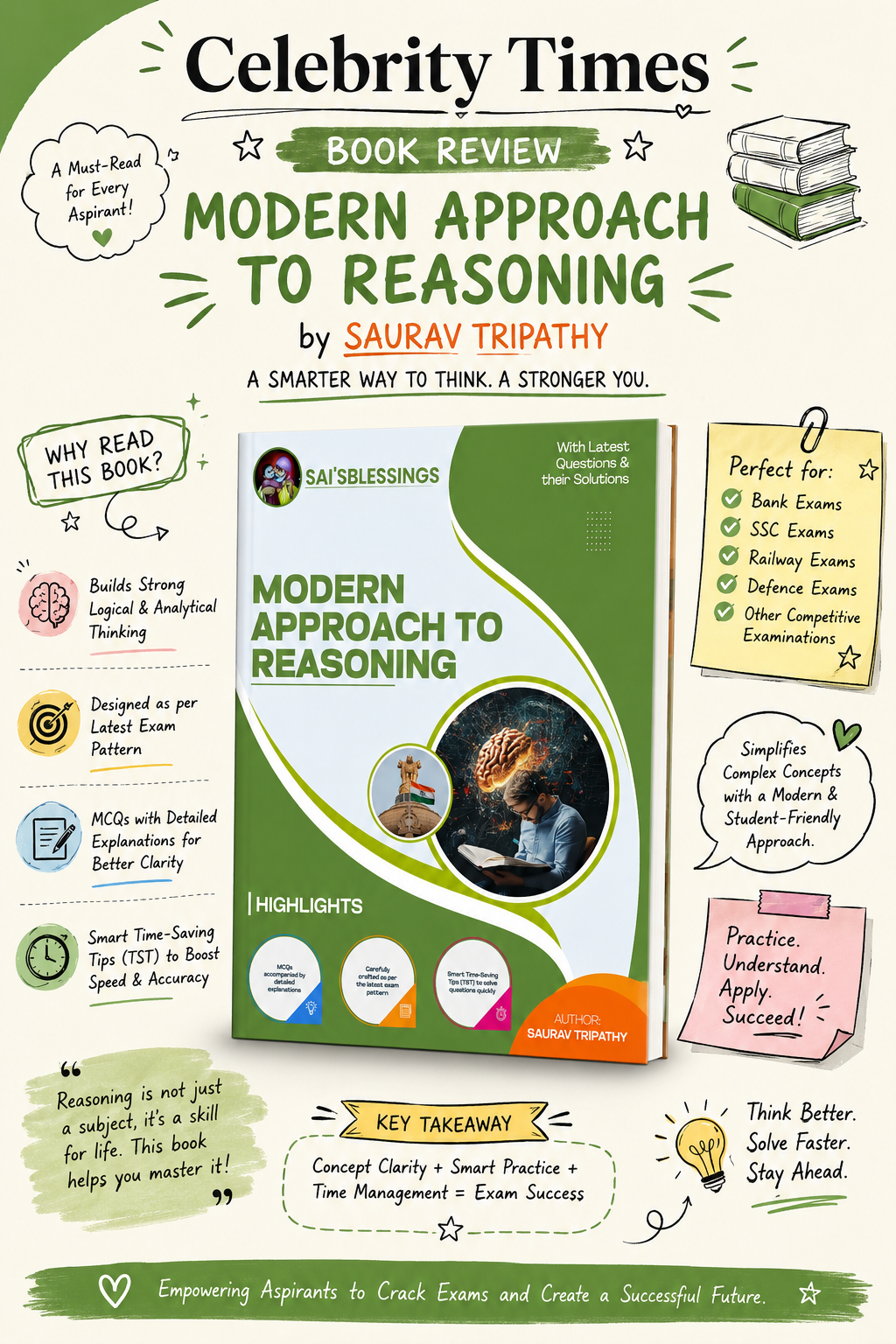
A Practical Reasoning Guide for Every Competitive Exam Aspirant
Competitive exams are becoming more challenging every year, and one section that many students find difficult is Reasoning. Whether it is UPSC CSAT, SSC, Banking, Railways, State PSCs, Defence, Police, or any other competitive examination, reasoning demands both accuracy and speed. Modern Approach to Reasoning by Saurav Tripathy is a book that aims to make this subject easier, more systematic, and less intimidating for students.
From the very first page, the book gives the feeling that it has been prepared with a student’s needs in mind. Instead of filling pages with lengthy theories, the author focuses on helping readers understand concepts through simple explanations, solved examples, practice exercises, and detailed solutions. The language remains easy throughout the book, making it suitable even for beginners.
One of the strongest features of this book is its well-organized structure. The topics are arranged in a logical order so that learners can build their understanding step by step. It begins with number and letter series before moving into missing value in figures, analogies, odd one out, coding-decoding, blood relations, directions, ranking, cubes and dice, Venn diagrams, syllogisms, mathematical operations, counting figures, logical reasoning, and finally non-verbal reasoning. This gradual progression makes learning much more comfortable.
The section on series deserves special appreciation. Instead of simply giving answers, the author explains different approaches to identifying patterns. Students are encouraged to observe differences, multiplication patterns, squares, cubes, alternate sequences, and mixed series. This approach helps learners understand the logic instead of depending on memorisation.
Another highlight is the chapter on Missing Value in Figure. Such questions often confuse students because different examinations use different patterns. The book explains multiple methods with clear examples before moving on to practice questions, making it easier to recognize similar patterns in exams.
The Analogy chapter is equally useful. Both verbal and numerical analogies are explained with relatable examples before introducing practice questions. The same learning pattern is followed throughout the book—concept first, examples next, exercises afterwards, and finally detailed solutions. This consistency makes self-study much easier.
The Non-Verbal Reasoning section is particularly impressive. It covers figure series, analogy, mirror images, water images, paper folding and cutting, and several visual reasoning questions that frequently appear in competitive examinations. The illustrations are neat, and the answer explanations help readers understand why a particular option is correct rather than simply telling them the answer.
A feature that makes this book stand out is the detailed solution section. Every exercise is followed by answers along with brief explanations of the underlying pattern. Students who make mistakes can quickly identify where they went wrong and improve their understanding. This is especially helpful for self-learners who may not have access to coaching.
The book also includes recent exam-style questions, which make the practice more relevant. The questions are neither unnecessarily complicated nor too easy. They provide a balanced level of difficulty that can help students prepare confidently for a wide range of competitive examinations.
The presentation is clean and student-friendly. Important information is easy to locate, the chapters are clearly divided, and the examples are simple enough for quick revision. The inclusion of shortcuts and time-saving approaches is another positive aspect, particularly for exams where speed is as important as accuracy.
Of course, no preparation book can replace regular practice. Students will benefit the most if they solve the exercises without looking at the solutions first and then carefully study the explanations. Used consistently, this book can become an effective companion for strengthening reasoning skills.
Overall, Modern Approach to Reasoning succeeds in its goal of simplifying one of the most important sections of competitive examinations. It combines conceptual clarity, structured learning, plenty of practice, and useful explanations into a single volume. Whether you are preparing for your first competitive exam or revising your reasoning concepts after a gap, this book offers a practical and approachable learning experience.
Final Verdict: 4.7/5 ⭐
Modern Approach to Reasoning is a thoughtfully designed practice and concept-building guide that makes reasoning easier to understand without overwhelming the reader. Its simple language, exam-oriented content, and detailed explanations make it a valuable resource for students preparing for competitive examinations across different levels.