What happens when the perfect world you grew up believing in begins to reveal the machinery hidden underneath it?
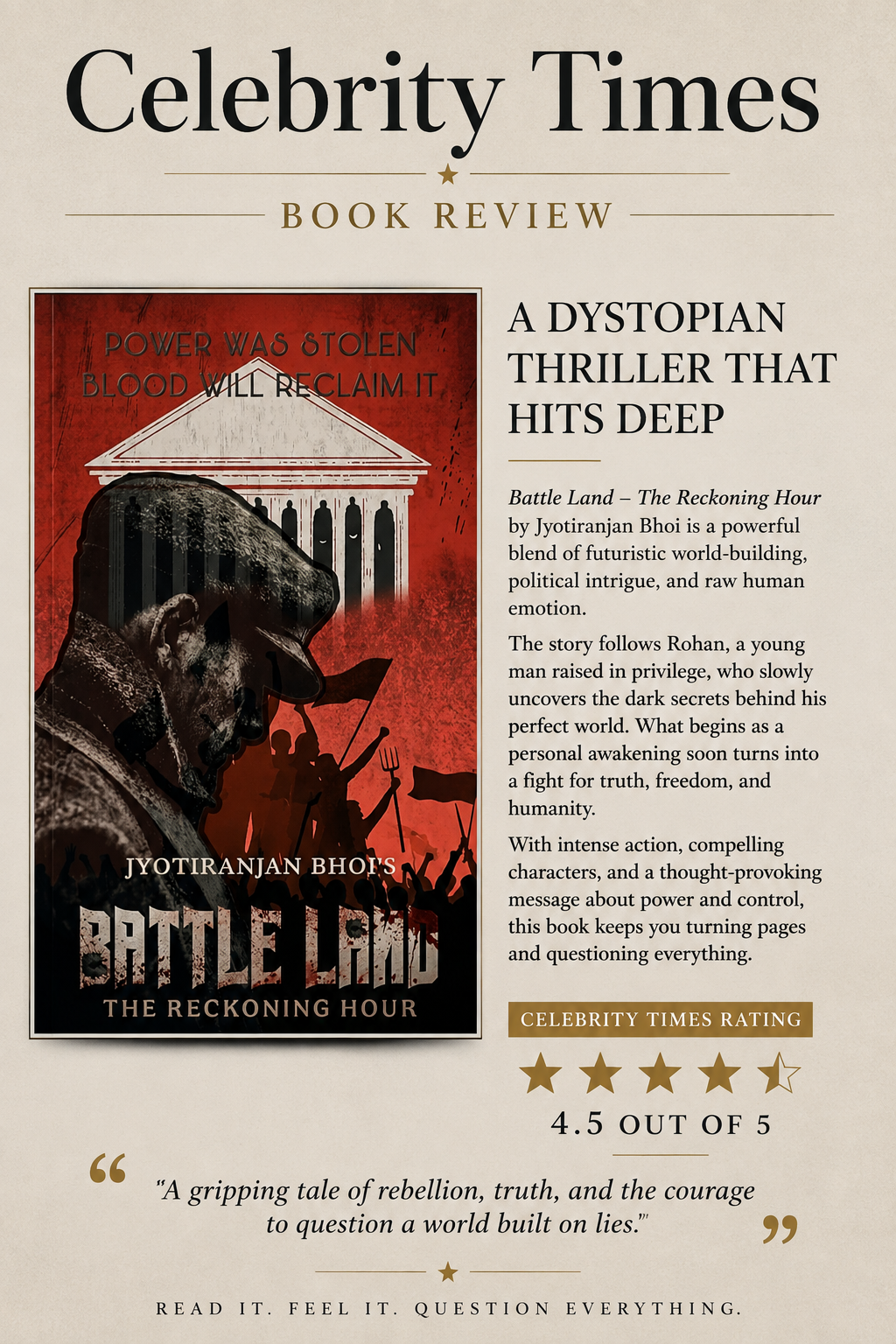
Battle Land – The Reckoning Hour opens in the middle of a violent revolution, throwing us straight into a world of burning government buildings, automated enforcement drones, plasma weapons and a collapsing political regime. But what makes the story interesting is that it doesn’t stay in the battlefield. It takes us four years backward, to the peaceful university life of Rohan Anand—the privileged son of Minister Makrand Anand—and slowly shows us how that seemingly perfect world begins to crack.
Rohan is an engineering-minded, analytical young man who has grown up surrounded by wealth, political power and absolute security. At university, he has Anyaa beside him, a lively and perceptive friend who brings warmth to his otherwise intensely logical personality. Their conversations about governance, censorship and the seemingly flawless state provide an important contrast to the chaos that we know is coming.
And then Rohan discovers something disturbing.
Hidden government records reveal that students are being subjected to something called “Administrative Redirection”, with their identities being erased from the central system. One of the names is Rahul Varma, a student activist who had openly questioned the regime. Suddenly, the perfect society Rohan knows begins to look very different.
What I particularly liked is the way the story connects technology with political control. Security systems, biometric surveillance, automated drones, data networks and cryptographic terminals aren’t simply futuristic decorations. They become instruments of power. The book repeatedly asks an uncomfortable question: when technology is controlled by an authoritarian system, does it create security—or make oppression more efficient?
Rohan’s personal journey is therefore also the journey from privilege to awareness.
The contrast between the golden university campus and the destroyed capital is one of the strongest elements of the narrative. The campus represents innocence, comfort and the illusion of safety, while the future battlefield represents everything that was hidden beneath that beautiful surface. The transition between these two worlds gives the story its emotional weight.
I also enjoyed the relationship between Rohan and Anyaa. Their interactions bring a softer, more human dimension to an otherwise heavily political and technological story. Their ordinary university conversations become more meaningful because the reader already knows that the peaceful world they’re enjoying has an expiration date.
The writing is particularly visual. The author uses strong descriptions of smoke, concrete, marble, steel, blue plasma, crimson skies and enormous government architecture to build a cinematic dystopian atmosphere. The opening chapters immediately feel like scenes from a futuristic political thriller.
At the same time, the book isn’t only about revolution. Beneath the action is a story about power, privilege, censorship, surveillance, family loyalty and the uncomfortable discovery that the people closest to you may be connected to the system you’re beginning to question.
And that, for me, is what makes Battle Land intriguing.
It isn’t simply asking “Who will win the war?”
It is asking:
“What created the war in the first place?”
💭 My Take
What I found most compelling was the book’s gradual unveiling of the truth. We know from the beginning that Rohan’s world will eventually collapse, so watching him live through the years before the revolution creates a sense of impending tragedy. His comfortable university life starts feeling less like a safe haven and more like a countdown.
The book also leaves several questions hanging—which works well for a Book 1. Rohan’s relationship with his father, the government’s hidden operations, Professor Rai’s role, the disappearance of students like Rahul, and the eventual rebellion all suggest that there is a much larger story still waiting to unfold.
📚 Final Verdict
Battle Land – The Reckoning Hour is a promising dystopian political sci-fi thriller that combines futuristic technology with questions about authoritarianism, privilege and the price of “perfect” governance.
If you enjoy dystopian fiction, political thrillers, futuristic technology, rebellion narratives and stories where a seemingly perfect society slowly reveals its darker side, this is a book worth exploring.
The most interesting part isn’t the battle itself—it’s discovering why the battle had to happen.