Long before I thought of myself as a writer with a career, I wrote poetry. That was where the noise in my head found some order. I watched the world through metaphors and half-finished stanzas, trying to hold onto small truths before they slipped past.
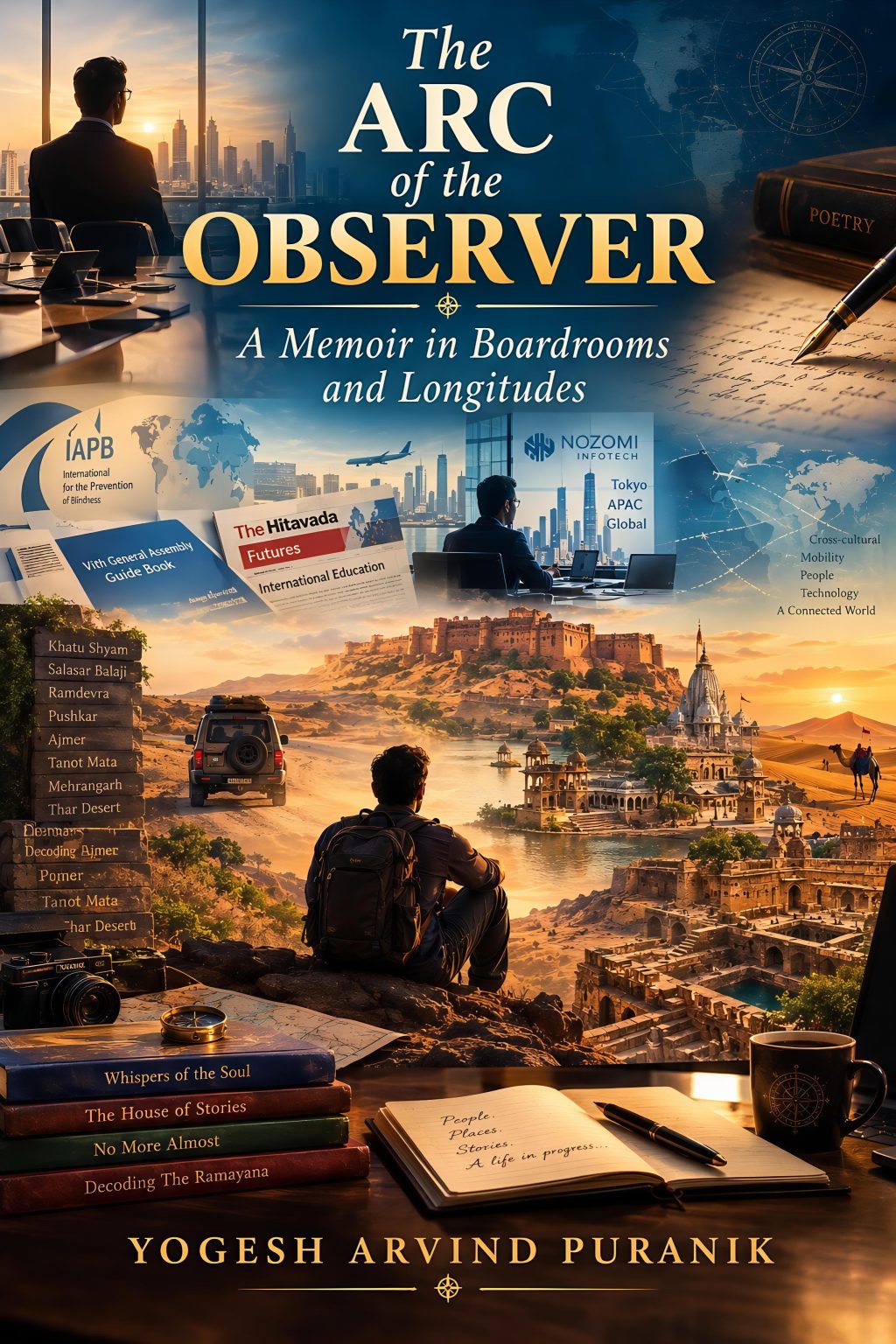
I didn’t go straight into literature, though. My real training happened somewhere else entirely: inside the machinery of large organizations. At the International Agency for the Prevention of Blindness (IAPB-LVPEI) in Hyderabad, I was given the job of editing and publishing the VIth General Assembly Guide Book for distribution worldwide. That project took the mystique out of writing for me. It wasn’t about waiting for inspiration anymore. It was proofreading, typesetting, deadlines, and the responsibility of getting something right for an audience you’d never meet.
Later, running operations at Krishna Consultants, I started writing for the public. My columns in The Hitavada Futures dealt with international education, and readers seemed to respond less to the information itself than to how it was told. By the time I reached senior leadership at Nozomi Infotech, working with Tokyo and the broader APAC region, I was writing about cross-cultural mobility and where human skill meets new technology.
I didn’t notice it at the time, but those two decades in corporate life were shaping the novelist I’d eventually become. You learn a lot about people in boardrooms and negotiations — ambition, loyalty, grief, silence, all of it shows up eventually. Corporate work gave me discipline. Managing people gave me something closer to empathy.
By 2019, after more than twenty years in that world, I went back to writing. It didn’t feel like starting over. It felt closer to picking up something I’d set down.
My first book, Whispers of the Soul, came out of years of private reflection and went on to receive the 21st Century Emily Dickinson Award. From there I moved into fiction — The House of Stories: Mira’s Chronicles, recognized by the Tagore Commemorative forum, and then No More Almost: The Space Between Breaths, which won the Sahityakosh Samman and dealt with human resilience.
But somewhere along the way I understood that imagination on its own wasn’t going to be enough. When I started working on The House of Anand Rathore, a multi-generational saga, I knew I couldn’t write the havelis and the desert from a desk in another city. So I didn’t try to.
I drove alone, over 5,300 kilometers, through the heart of Rajasthan and out to its desert edges.
I stopped at Khatu Shyam, Salasar Balaji, Ramdevra, Pushkar, Ajmer. I stood in the Sam sand dunes and watched the light change over the Thar. I paid my respects at Tanot Mata, near the Indo-Pak border, and spent an evening at Mehrangarh watching the fort catch the last of the sun. I walked the ruins of many forts across many districts, seats of the Rathores and other clans, not all of them but many now forgotten. I walked through stepwells that had mostly been forgotten and tried to absorb what was left of the old Rajasthani households — how they were built, how people might have lived in them. None of that made it onto the page until I’d actually stood in it.
My forthcoming book, Decoding The Ramayana: An Ancient Blueprint for the Modern Mind, asked something different of me — less physical, more internal.
I didn’t come to this project academically. It came out of a period of real loss and caregiving in my own life, a time when the usual answers weren’t holding up. I turned to the Ramayana, a text I’d mostly known through ritual, and found in it a way of thinking about suffering and duty that I hadn’t expected. Putting that into prose has probably been the hardest writing I’ve done. I had to work through a lot of assumptions I didn’t know I was carrying, and look at the epic across four layers — the narrative itself, the psychological archetypes, the philosophical grounding, and how it applies to an ordinary life. At its core, it’s trying to say something simple: that a small act of service matters more than we tend to think.
Looking back at the corporate years, the drive across Rajasthan, and the nights spent writing when I couldn’t sleep anyway — I don’t know that I’d call it all a plan. But none of it feels wasted, either. I write now because it’s still the one place I know of where the scattered parts of a life can be put down and make some kind of sense.