

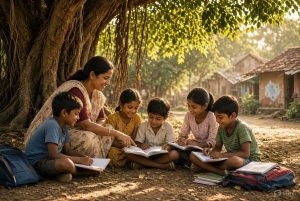
 Education has the power to lift entire families out of hardship and to open doors that once seemed firmly shut. When every child, regardless of where they are born or how little money their parents have, can sit in a classroom and learn, societies grow stronger and fairer. Public policies have tried for decades to make this dream real. Governments have written laws that declare schooling free and compulsory, they have built classrooms, trained teachers, and offered midday meals so hungry children can concentrate. These efforts have brought millions of children into school who would otherwise have stayed outside. Yet the journey remains unfinished. In remote villages, in crowded urban slums, and among families that move from place to place for work, many children still never see the inside of a classroom for long. Policies alone cannot always reach them. That is where the warmth and agility of charitable action become essential.
Public policies set the broad framework. They decide that every child has a right to learn, they allocate money from the national treasury, and they create systems for inspection and accountability. In many countries these measures have raised enrolment rates dramatically. A child who once walked miles to fetch water can now walk to a school that is free. A girl who might have been kept home to help with household chores is now expected by law to attend classes. Scholarships for the poorest families, free textbooks, and special programmes for children with disabilities are all products of deliberate policy choices. These steps matter deeply. Without them, education would remain the privilege of those who can already pay.
Even the best designed policies face real limits. Money does not always arrive where it is most needed. Teachers may be appointed on paper but rarely show up in distant schools. Buildings stand empty because there is no electricity or safe drinking water. In places where families struggle to earn a daily wage, the cost of a uniform or a pair of shoes can still keep a child away. Cultural beliefs sometimes discourage girls from continuing beyond a certain age. Children who speak a different language at home may find the classroom alien. Policies can announce solutions, yet they move slowly, and the people who write them are often far from the daily realities of the children they hope to serve. The result is that large groups remain outside the reach of formal systems.
Charitable action can fill these gaps with speed and humanity. A single donor, a local group of friends, or an established organisation can decide tomorrow to support a particular village or a particular child. They do not need to wait for budgets to be approved or for forms to be filled in triplicate. A retired teacher can spend two hours each evening helping children with their lessons under a tree. A group of young professionals can collect used books and carry them to a neighbourhood that has no library. A company can set aside a portion of its profits to pay the fees of a hundred students who would otherwise drop out. These acts are small on their own, yet they accumulate. When many people act in the same spirit, the circle of those who receive an education grows wider.
One powerful way charities enlarge access is by meeting children where they already are. Mobile classrooms travel to the places where families live in temporary shelters. Volunteers who speak the local language sit with parents and explain why keeping a daughter in school will one day help the whole household. Scholarships are given not only for tuition but for the quiet expenses that policies overlook: bus fare, spectacles, sanitary products, or a meal after school. In cities, evening classes are offered for children who work during the day. In rural areas, community learning centres open on weekends so that older brothers and sisters can study without missing the harvest. Each of these efforts reaches groups that the formal system has not yet managed to include.
Charities also strengthen the quality of what children receive once they arrive. They train local young people to become assistant teachers, so that classrooms are not overcrowded and children receive more personal attention. They supply simple science kits or story books that make lessons come alive. They create safe spaces after school where children can finish homework instead of wandering the streets. When a child falls behind, a volunteer can sit beside them and patiently explain the same idea again until it is understood. These personal touches turn a distant right into a lived experience of care.
Partnerships between public policy and charitable effort multiply the effect. Governments can continue to provide the buildings and the official teachers, while charities supply the extras that make attendance possible and learning joyful. A public school can receive a donation of computers or a small library. Health camps organised by a charity can ensure that children are well enough to study. When both sides listen to each other, duplication is avoided and more children benefit. The policy guarantees the foundation; the charity adds the warmth that keeps children coming back.
Reaching still larger numbers requires that charitable actions become visible and easy to join. Local leaders can organise neighbourhood collections so that every household contributes a little. Stories of children who have succeeded because of a scholarship can be shared in community meetings and on simple radio programmes. Young people looking for meaning in their free time can be invited to mentor one child for a year. Religious groups, cultural associations, and alumni of schools can each adopt a nearby community. When giving becomes a normal part of everyday life rather than an occasional grand gesture, the pool of support grows naturally.
The language we use matters. Instead of speaking only of targets and percentages, we can speak of the girl who learned to read and then taught her younger brother, of the boy who became the first in his family to finish secondary school and now sends money home, of the teacher who stayed in a difficult posting because a few volunteers stood beside her. These human stories remind everyone why the effort is worthwhile. They also inspire new donors who might otherwise feel that their contribution is too small to count.
Education for all is not finished when a law is passed or a school is built. It is finished when every child who wants to learn can do so without fear of cost, distance, or rejection. Public policies create the pathways and the legal promise. Charitable actions walk those pathways with the children who might otherwise be left behind. Together they form a bridge strong enough for larger and larger groups to cross. Each book given, each hour volunteered, each scholarship offered is a quiet declaration that no child should be left outside the circle of learning. When enough people make that declaration with their time and their resources, the circle expands until it includes everyone.