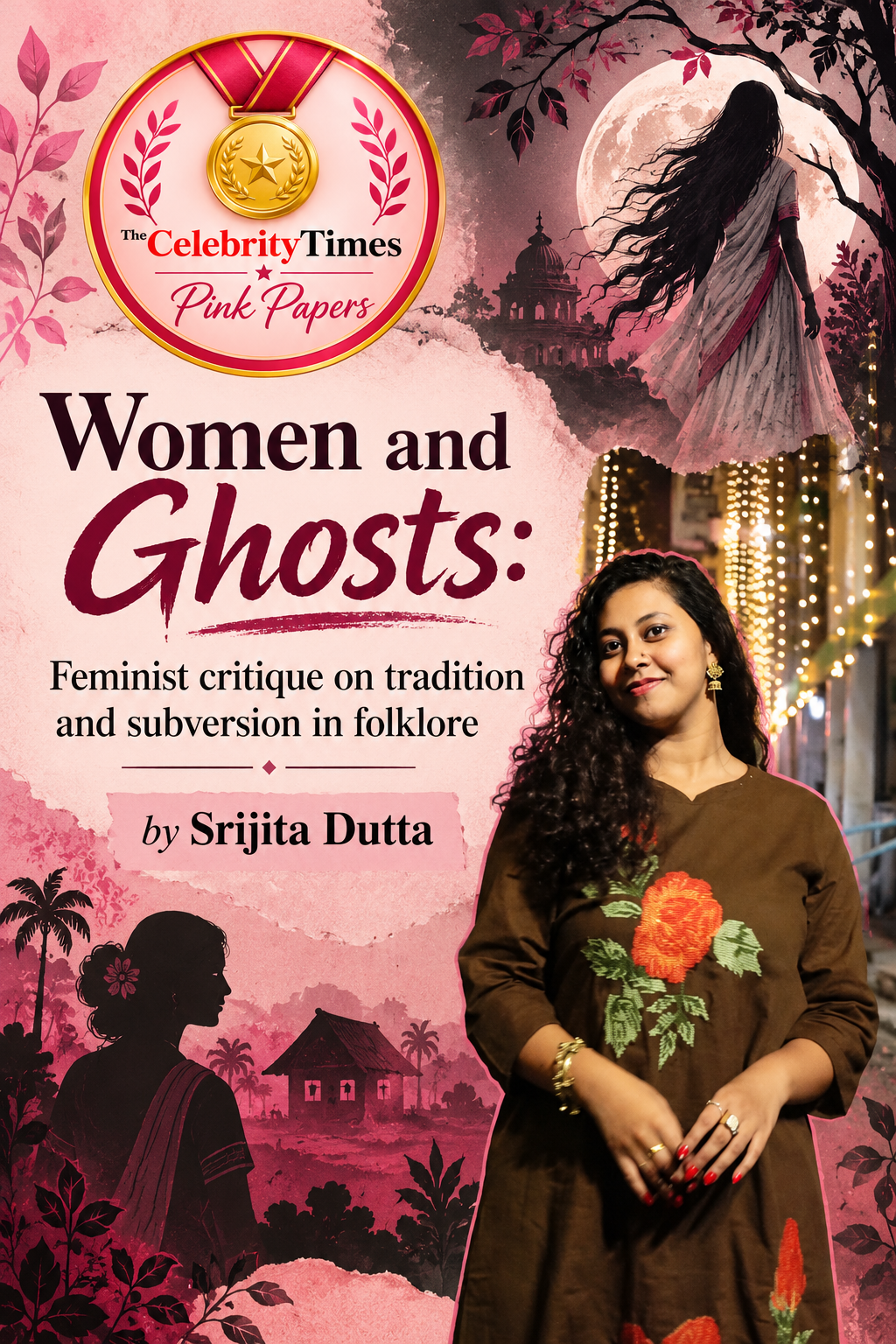
The dictionary defines “ghost” as a spirit of a dead person seen and heard by living people. The trope of “ghost” is a popular trope in most mythological tales and folklore. By “ghost” here, I mean any supernatural entity that does not belong to the rational, scientific, self-contained world. In other terms, the “other” to the world of men and science. This includes both ghosts and women, especially in mythology and folklore.
In folklore, it is a recurring pattern that many, if not most, ghosts are women and these female ghosts are spirits of women who have had tragic lives when alive. Like the ghost Shakchunni is the spirit of a married woman who either died prematurely or had unfulfilled domestic desires. As a result, she has become a vengeful spirit who often tries to possess young, married women to fulfill her desires.
The figures of the “petni”, “dakini”, and “dayini” are also interesting. Sometimes used alternatively. The word “petni” refers to an unmarried female spirit who has died of an unnatural cause, rape could be one of them, or due to unfulfilled desires or died prematurely. The word dakini alternatively means a servant of Goddess Kali like the terms “Dakini, Yogini” or a witch who practices the dark arts and has to be tortured and exorcised. The dayini is also a witch who conforms to the latter definition of dakini.
These female ghosts are alternatively seen as threats and a corrupting force to the patriarchal society. Ghosts such as Mamdo bhoot (spirit of a Muslim man who has died of unnatural causes) and Brahmadaitya (spirit of a Brahmin who has died either prematurely or of unnatural causes) are described as either neutral or relatively harmless. Brahmadaitya is shown as elevated and relatively harmless and sometimes even helpful guides. Myths regarding the mamdo bhoot differ from region to region, with some regions viewing them as violent and others viewing them as either neutral or relatively harmless.
Even though the female ghosts are seen as relatively harmless or even comedic sometimes, they are still viewed as transgressors of the patriarchal society, a threat to the society. They symbolize the plight of women and their reduced sense of identity in a society that gives importance to a woman based on certain criteria. These criteria include but are not limited to: childbearing, obeying the husband, doing all the household chores, emotional labour, endurance, silence, and smiling incessantly. If a woman does not fulfill these, she remains incomplete or on the margins of society, not worthy of respect.
This is where good-bad binary comes in. The “good” woman is someone who conforms to the bounds set by patriarchy and the “bad” woman is someone who transgresses these bounds, anywhere from not marrying and achieving a patriarchal appropriation of “womanhood” to trying to harm men and corrupt innocent, unsuspecting women and by extension, the patriarchal family.
The female ghosts are mainly viewed as corrupt beings who are dangerous not for personal reasons or for the greater good but viewed as malevolent spirits sent to destroy patriarchal domesticity and corrupt young women. They are viewed as threats to the patriarchal authority that men enjoy. The female ghosts with their distorted figures, big talons and backward feet, classic characterizes popularized by myths and further mythologized by popular culture, becomes a distortion of the societal perception of how a woman should be. They symbolize the difficulties of women in the domestic space and the patriarchal fear of the untamed, wild feminine.
In the cases of Shakchunni and petni especially, they are associated with their marital positions which become a big part of their identity. It explains the reason for their thirst for revenge or a desperate search for taking back agency. It is on the basis of their marital position that they are described and many times, even trivialized because of it.
If seen in another way, the trope of the supernatural is used as a way to critique patriarchy without making it too obvious. Often fantastical and supernatural elements are used to indirectly critique things in society. The use of female ghosts as malevolent, vengeful, spiteful go against the notion of a submissive, docile woman which even controls what emotions a woman must feel. The radical shift in the portrayal of emotions and the addition of rage becomes a direct critique of the patriarchal notion of a woman while also being discreet.
However, this anger is seen as something to suppress as this is not something that “good” women do. The spirit is the other, which must be tamed. Therefore, an ojha or a tantric, a masculine figure is called in to tame the spirit and exorcise using aggressive and violent methods, which almost borders on sexual violence. The anger of women is either seen as something to repress when it threatens male authority and control. It also threatens the notion that women aren’t supposed to be angry or if they are angry then it is trivialized. It re-enforces the notion that male violence is a solution to restoring the patriarchal balance in society, which mostly involves violating and torturing women who have transgressed societal norms.
It is easy to worship Ma Durga and Ma Kali for their divine anger, rage, and their violence as they are goddesses, elevated and detached from society. The ones within the society who display an ounce of their subversion and rage- ranging from speaking up, education to exploring the dark arts like male tantrics- are ostracized, beaten and tamed as they threaten patriarchal control.
While many female ghosts are powerful spirits who are feared for harming men and corrupting innocent women in a patriarchal setting, they are stripped of agency by patriarchal narratives about them that villainize them and make them threats to the very fabric of society itself: which is patriarchal authority. I believe we need more narratives about female ghosts taking back agency and control, written by women for uplifting other women instead of internalizing misogyny and competing with other women. Let us break through the bounds of patriarchy and uplift all those who have been otherized and marginalized for being “different.”