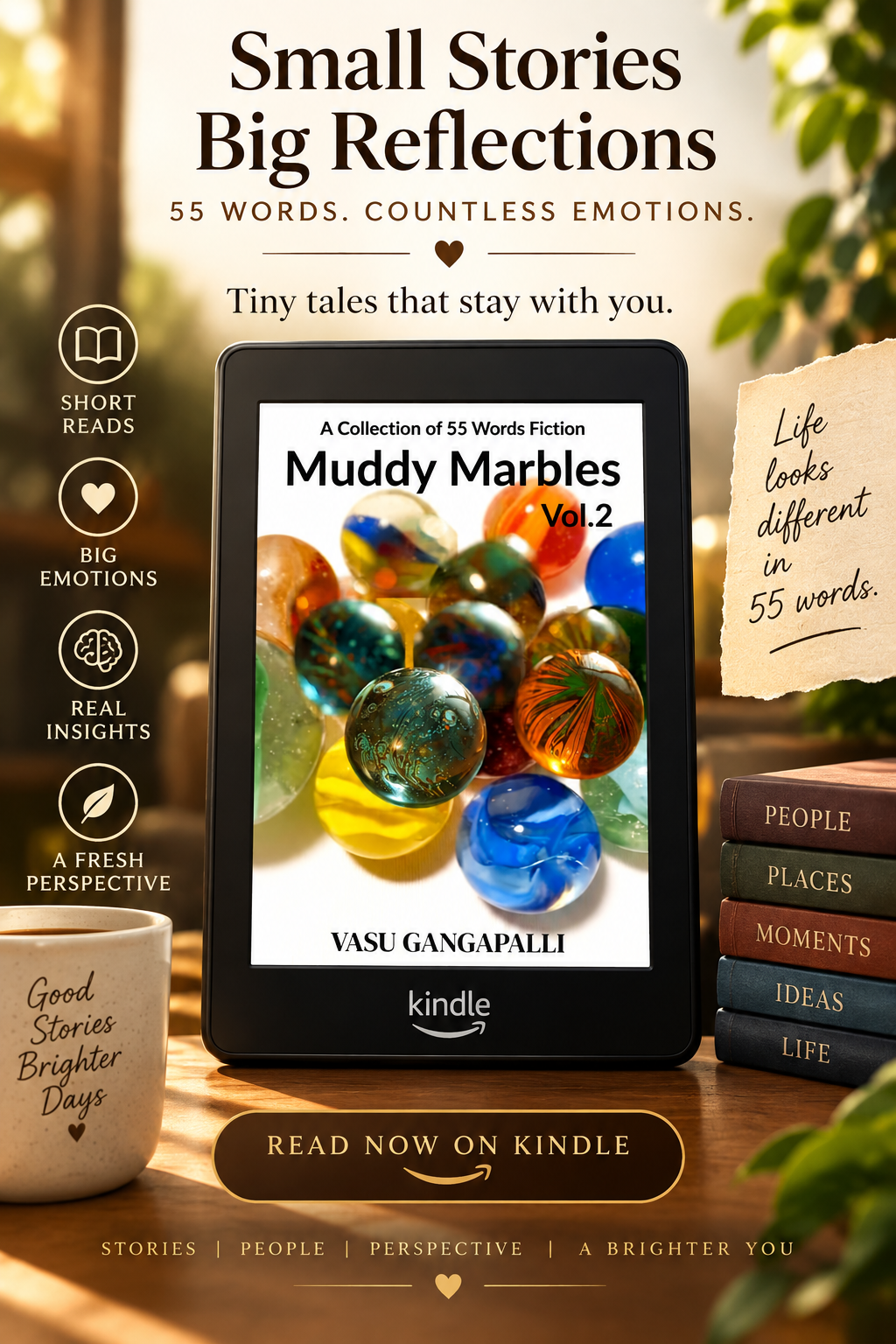
A Collection of 55 Words Fiction
By Vasu Gangapalli | Edited by Shraddha Handigi
Some books take hundreds of pages to tell a story. Muddy Marbles – Vol. 2 does something very different. It takes only a few lines.
Vasu Gangapalli’s Muddy Marbles – Vol. 2 is a collection of very short fiction pieces, built around the idea of telling a complete story in just 55 words. At first, this may sound like a simple concept, but writing a story this short is actually quite challenging. There is hardly any space for unnecessary description or long conversations. Every sentence has to do its job.
And that is what makes this collection interesting.
The book contains stories covering many different moods and subjects. Some are funny, some are emotional, some are creepy, while others leave you thinking about life, society, relationships and human behaviour. The stories are completely different from one another, so the book never feels like it is following just one particular genre.
One of the things I liked about the collection is how quickly the stories get to the point. There is no long introduction or unnecessary background. A situation is presented, the reader gets a few clues, and then comes the ending—often with a small twist.
For example, “The Face” immediately creates a strange and uncomfortable situation. A person looks into a bathroom mirror and discovers that the reflection does not seem to be his own face. The small detail about the scar makes the situation even more mysterious, and the final image of the reflection grinning wickedly gives the story its creepy punch.
Similarly, “The Knock” uses a very familiar horror setting—a strange knock in the middle of the night, a power cut and an opening wardrobe door. The story stops at exactly the point where the reader begins wondering what is inside. That ability to create suspense in just a few lines is one of the strengths of the book.
There are also stories where the twist is more humorous. “Grandpa’s Ghost” is a good example. A student explains why he missed school, saying that his grandfather passed away. His teacher then happens to see a recent Facebook picture posted by the grandfather. The student’s innocent explanation—“I think it’s his ghost!”—turns the situation into a funny little ending.
“Late” works in a similar way but with a more dramatic setup. A woman is watching news about a plane crash and wondering whether someone made it. Then the doorbell rings, and the person she was worried about appears at the door. His being late saved him from boarding the plane. It is a very simple idea, but the timing of the twist works well.
The collection also has stories that are more emotional.
“Just Live” is perhaps one of the simplest examples. Two friends talk about their wishes. One wants a new house, a new car, a smartphone and other everyday things. The other says that she simply wants to defeat cancer and live. That contrast makes the story meaningful without needing a long explanation.
Then there is “Tania”, which initially sounds like a story about losing a close friend. Only at the end do we discover that Tania is actually a goldfish. It is a small twist, but the emotional setup makes the ending surprisingly touching.
“Worthless Money” takes a different approach. A wealthy man offers money to a farmer who is hungry, but the farmer refuses because money has no value to him when his land is barren. The image of the rich man standing among his huge buildings while the farmer walks away gives the story a clear message about the difference between wealth and actual human needs.
The book also touches on social situations. “The Molester” is particularly interesting because it begins with a crowded bus and a woman’s accusation. The crowd immediately turns against the man, but the story then introduces another possibility—that what happened may have been an accident. The ending makes the reader pause and think about how quickly people can judge someone without knowing the complete situation.
There is also plenty of imagination in the collection.
“Playing God” brings in a stranger dressed as Lord Shiva who claims to be God. The watchman does not believe him, and the stranger mysteriously disappears at a dead end. It is a tiny supernatural story, but it leaves the reader with a question rather than a complete explanation.
“Love at first sight” gives the idea of romance a funny twist by bringing zombies into the story. Instead of a typical love story, the conversation between a zombie mother and her son turns the familiar phrase into something completely unexpected.
“Twist in Love” takes the idea in another direction, using reincarnation. A man feels that a woman looks familiar, only to learn that there is a connection between them from a previous life. Again, the story depends almost entirely on its final revelation.
One of the most enjoyable things about Muddy Marbles is this variety. You can move from a horror story like “The Candle Light” to a humorous piece like “Company,” where two fish find comfort in having each other inside a fish bowl. Then you can come across something more emotional or philosophical in the very next story.
“The Window Seat” is another gentle story. A woman who does not like sitting by the window agrees to exchange seats with a twelve-year-old girl. The girl gives her a candy bar in return. It is a very small moment, but it captures kindness and simple human interaction.
The collection also plays with the idea of storytelling itself. “Happy Ending” is especially clever because the character seems to speak directly to his creator, asking for a happy ending after experiencing so many tragic ones. It creates a nice connection between the writer, the character and the reader.
And “Next Story” adds another layer of fun. Three people enter a haunted house and tell ghost stories. After they finish, a mysterious voice begins telling a story about three men entering a haunted house. Suddenly, the people who were telling the stories may have become part of one themselves. It is a neat way of playing with the idea of fiction within fiction.
The title Muddy Marbles also feels appropriate for a collection like this. Each story is like a small marble—tiny, separate and different in colour and shape. You pick one up, look at it for a moment, discover what is inside, and then move on to the next.
The biggest challenge with this format is also its biggest limitation. Because the stories are so short, some ideas naturally feel like they could have been explored further. A few endings can feel abrupt, especially when the reader becomes interested in the characters and the story suddenly ends. But that is also part of the nature of 55-word fiction. The writer is deliberately leaving much of the story to the reader’s imagination.
The writing itself is straightforward and easy to follow. There is no complicated language, which makes the collection accessible to casual readers as well as people who enjoy flash fiction. You can read several stories in one sitting, or simply pick up the book whenever you have a few spare minutes.
Another good thing about the book is that it does not demand a lot of time from the reader. Each story gives you a small experience—a laugh, a surprise, a creepy moment, an emotional thought or a question—and then lets you move on.
Overall, Muddy Marbles – Vol. 2 is an interesting experiment in short-form storytelling. Vasu Gangapalli shows that a story does not always need many pages to create an impact. Sometimes a handful of carefully chosen words can be enough to create a complete situation and leave the reader with something to think about.
It is a book that works particularly well for readers who enjoy flash fiction, unexpected endings, short horror pieces, humour, emotional moments and stories that make you stop for a second after the last line.
If you enjoy books that you can open anywhere and read a story in just a minute or two, Muddy Marbles – Vol. 2 can be a fun little collection to keep around. The stories are small, but each one carries its own little world—and that is the charm of this book.