We keep talking about the epics “coming back.” As if they left.
They didn’t. The Ramayana and Mahabharata have been humming underneath everything this subcontinent has ever done: temple walls, grandmother’s bedtime voice, the Ramlila ground, even those Sunday morning TV serials we all pretend we didn’t cry watching. They never went anywhere.
What happened is subtler, and frankly more insulting. We demoted them. We shoved our Itihasa into the nursery and called it mythology. Bedtime stories. Fantasy material for comic books. Somewhere along the way we decided that the deepest philosophical architecture our civilization ever built was something to outgrow, a story you tell a child and then set aside once you’re old enough for real ideas.
I don’t say that out of nostalgia. I say it because it’s urgent, and here’s why.
Modern storytelling, the kind we’ve inherited from the Western dramatic tradition, runs on a simple engine: hero versus villain, good versus evil, desire versus duty. The hero slays the monster, gets the girl, rides home. Clean. Satisfying. And not much use to you when you’re sitting in a hospital corridor at 3 a.m. trying to decide whether to sign the consent form or wait one more day. Or when your career wants one version of you and your family wants another, and either way you’re betraying someone.
Life rarely hands us a choice between right and wrong. More often it’s two rights that can’t both survive. Two duties pulling in opposite directions. Most of the time we’re not choosing between good and evil, we’re choosing which devastation we can live with and then trying to survive what’s left after.
This is where the epics leave Western drama behind. They aren’t interested in moral simplicity. They’re interested in Dharma Sankata, the impossible knot of competing duties.
Rama’s story isn’t really a victory march, though it gets told that way. It reads more like a slow, brutal education in what it costs to hold the world together. The Mahabharata is no cleaner. Even its avatars wade through gray zones where duty fights family, loyalty fights conscience, and winning ends up feeling a lot like losing. The Pandavas win the war and inherit a throne that smells like ash.
I learned this the hard way, not from reading about it but from living through it.
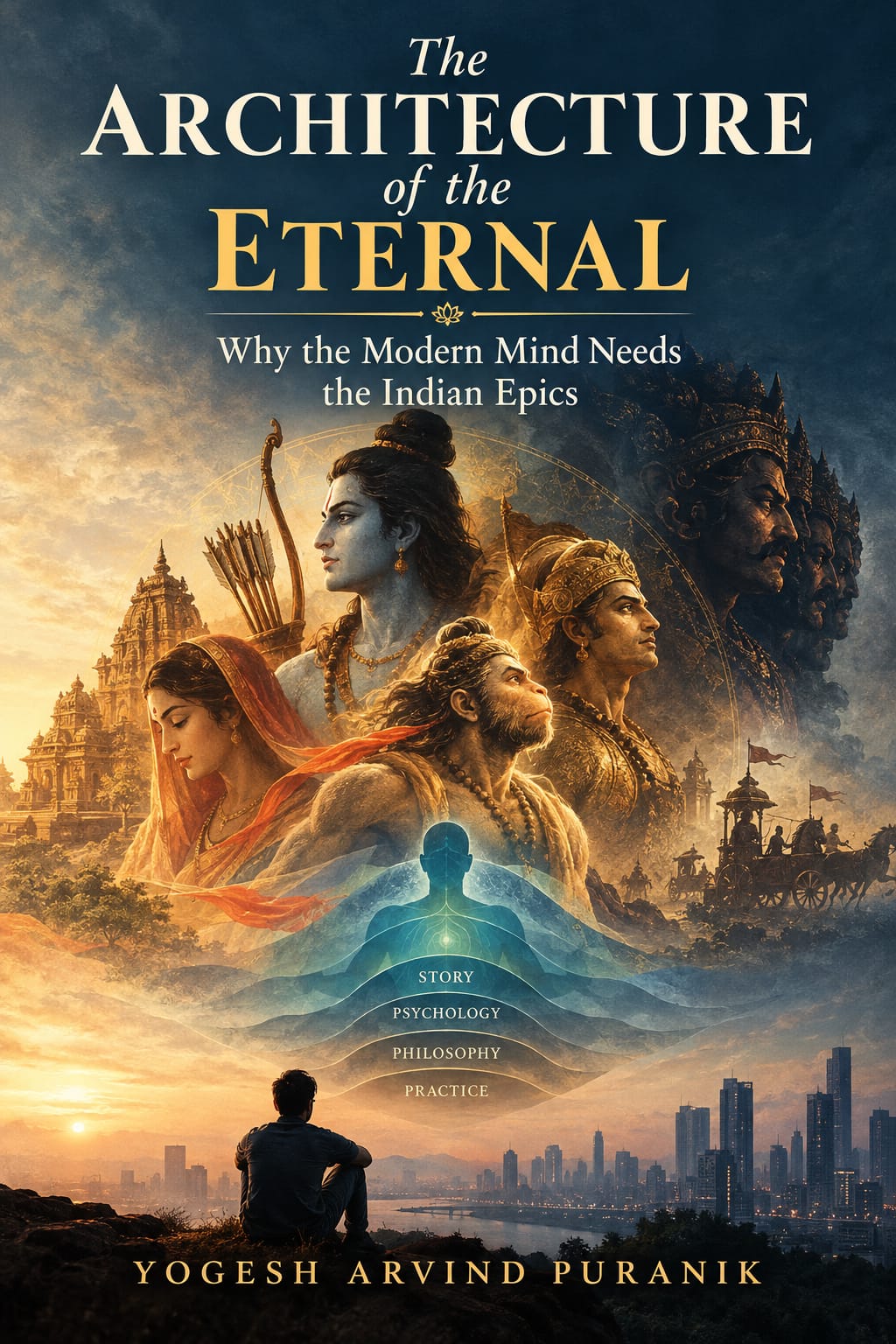
Writing The Forgotten Name of Kalki, and then later, during the years of caregiving and loss that eventually became Decoding The Ramayana: An Ancient Blueprint for the Modern Mind, I stopped treating these texts as devotional objects. Somewhere in that stretch of years I started seeing them as something closer to a cognitive framework, four layers deep, built by people who understood the human mind long before we had the vocabulary to describe it.
The first layer is just the surface story: kings, exile, war, reconciliation. Gripping enough on its own to hold a child’s attention, which is probably why it survived this long in that form.
Underneath that sits the psychological layer. Dasharatha is every man whose senses have overwhelmed his judgment. Ravana is every brilliant mind that forgot humility. Hanuman is something else entirely: the awakened breath, Prana itself, in service of Consciousness. He moves at the will of Rama, carries the strength of Sita’s pure energy, and stays in constant, quiet support of Lakshmana’s focused attention. He isn’t the ego bowing to something greater. He’s what becomes possible once the ego is no longer in the way.
Below that is the philosophical foundation, the engine running the whole thing: karma, nishkama karma, and the harder truth sitting under both, that everything you love is temporary and you have to act anyway.
And then there’s the layer almost nobody talks about, which is the practical one. Scaffolding for burnout, for grief, for a fractured sense of who you are, for the low grade existential dread that just hums under modern life without ever fully announcing itself.
We live in a century thick with algorithmic distraction, and somehow still spiritually starved. Hyperconnected, and often completely alone in the ways that matter. We’ve accumulated more data than any civilization in history and, if I’m honest, not much more wisdom about how to use it. We’ve started treating suffering like a scheduling error, an unfair interruption to the happiness we feel entitled to, which leaves us with nothing to stand on when real grief actually shows up.
The epics don’t hand you an escape from that. What they hand you is harder and more useful: a way to suffer with some dignity intact. They remind you that adversity isn’t a glitch in the system, it more or less is the system. It’s the forge. And freedom, real freedom, was never about indulging yourself endlessly. It’s closer to the opposite: choosing responsibility on purpose, even when it costs you something you can’t get back.
I should be clear about what “bringing them back” doesn’t mean. It doesn’t mean performing rituals nobody remembers the reasoning behind. It doesn’t mean another round of comic book adaptations that keep the fight scenes and quietly drop the philosophy underneath them. What it actually takes is engaging with these texts properly, with real intellectual rigor, some psychological honesty, and a willingness to ask the uncomfortable questions instead of skating past them.
We don’t need the epics so we can remember who we were. We need them because most of us have genuinely forgotten who we are, and there isn’t much time left to figure that out again.