So we’re supposed to be panicking, right? Language, that last sacred fence around the human soul, now pours out of machines by the gallon. Tap a key, get a sonnet. Tap another, get something that sounds suspiciously like Cormac McCarthy if he’d been raised on Reddit. Every writer I know is quietly asking the same question at 2 a.m: is there any point to me anymore?
Short answer: yes. But let me tell you why, not out of fear for what this means, but as someone who’s actually been inside the machine, building and directing these systems for years.
I’ve spent a career deploying enterprise scale AI across corporate environments: predictive modeling, risk analytics, decision pipelines that quietly replaced things people once swore needed “human intuition.” I wrote Prompt Engineering for the Modern Professional and Advanced Prompt Engineering out of a fairly simple belief, that professionals need to direct these tools, not just get steamrolled by them.
But my interest in this didn’t stay at the level of workflow mechanics for long. In my work on Quantum Duality Intelligence, I proposed a dual state model of machine cognition… what I call “Wave Intelligence,” the exploratory, continuous side of synthesis, and “Particle Intelligence,” the discrete, deterministic collapse into an output. The Archetypal Singularity, a companion piece, digs into the moral terrain of what happens when autonomous cognition starts resembling something like consciousness. Both papers are available on ResearchGate and my Google Scholar profile, if you want the long version.
Here’s what all of that tells me, once you strip away the mystique. Even the most sophisticated generative model is a statistical engine. A large language model moves through billions of tokens of human expression looking for the most probable next word. It’s a mirror: an enormous, extraordinarily detailed one, built from the accumulated residue of everything we’ve ever written down. But a mirror doesn’t have a pulse.
Literature is born from the opposite of probability. It comes from anomaly, from friction, from the gap between what language can say and what one particular person was forced to live through.
When people say AI has replaced original writing, I think they’re confusing fluency with depth. An algorithm can whip up a passable noir thriller or assemble a sonnet with clean meter. That’s aggregation. It isn’t creation. And if we’re honest, a lot of what commercial publishing has called “original” for the last few decades was already formulaic, genre tropes and stock plot beats arranged like furniture from the same three catalogs. AI didn’t kill originality. It just showed us the assembly line that was already running.
What it can’t do, what no amount of scaling will ever get it to do, is carry the weight of actually being mortal.
I can model autonomous decision making in the abstract all day. But a neural network has no stakes. Nothing to lose. It doesn’t know the terror of finitude, or what it costs to keep a duty you never asked for.
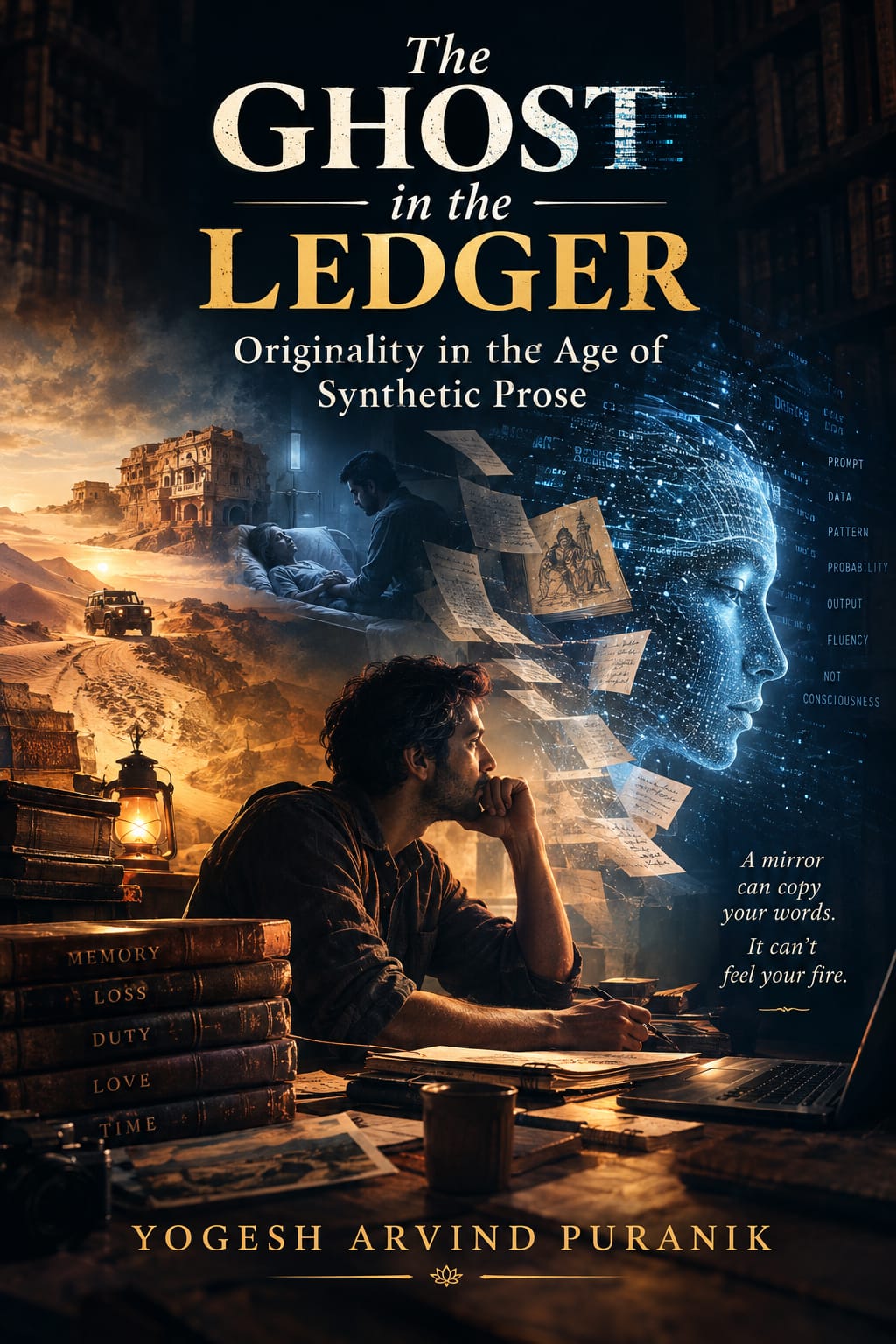
An algorithm has never driven five thousand kilometers alone through the Thar Desert, feeling the chassis shudder against a squall, just to understand how centuries of dust settle into the sandstone of a haveli nobody visits anymore. It has never sat through a midnight vigil beside a hospital bed, watching someone’s breathing for the small mercy of it staying steady, turning to the Ramayana at 3 a.m. because nothing else in the room was offering an answer.
A machine can generate the syntax of grief. It cannot grieve. It can produce a clean, structurally sound essay on sacrifice, but it has never had to give anything up to mean what it’s saying.
Originality was never about a rare adjective or a clever twist nobody saw coming. It’s closer to a collision: a writer’s actual scars, the decisions they can’t take back, whatever their family handed down to them without asking, and the fact that their time is running out same as everyone else’s. Readers aren’t really after syntactic perfection. If they were, we’d have stopped needing writers three years ago. What they’re after is contact, some evidence that another consciousness went through something real and came back able to describe it.
So no, I don’t think AI is making the human writer obsolete. I think it’s doing something closer to firing the ones who were coasting. It’s clearing out the market for lazy formula and cleverness with nothing under it, and it’s leaving the rest of us with a fairly uncomfortable question: what, exactly, do you have to say that a statistical average of the internet couldn’t have guessed?
A mirror can only throw back the light that hits it. It has no flame of its own.
Content, at this point, is not in short supply. If anything we’re drowning in it. What’s actually scarce is conviction: the sense that a person put something real on the line to write the sentence in front of you. That part hasn’t been automated yet. I’m not convinced it can be.