Every family has a person who keeps things running and rarely gets thanked. She remembers the medicines, the birthdays, who is not speaking to whom, and what needs to be said at the dinner table to keep the peace. We usually treat this as ordinary. The Ramayana, composed thousands of years ago, treated it as sacred.
The epic is mostly remembered for its men: Rama the exile, Hanuman the leaper, Ravana the ten-headed king. But the longer I stayed with the story while writing my book, Decoding the Ramayana: An Ancient Blueprint for the Modern Mind, the more I noticed that the men are carried by women.
The women who saw clearly
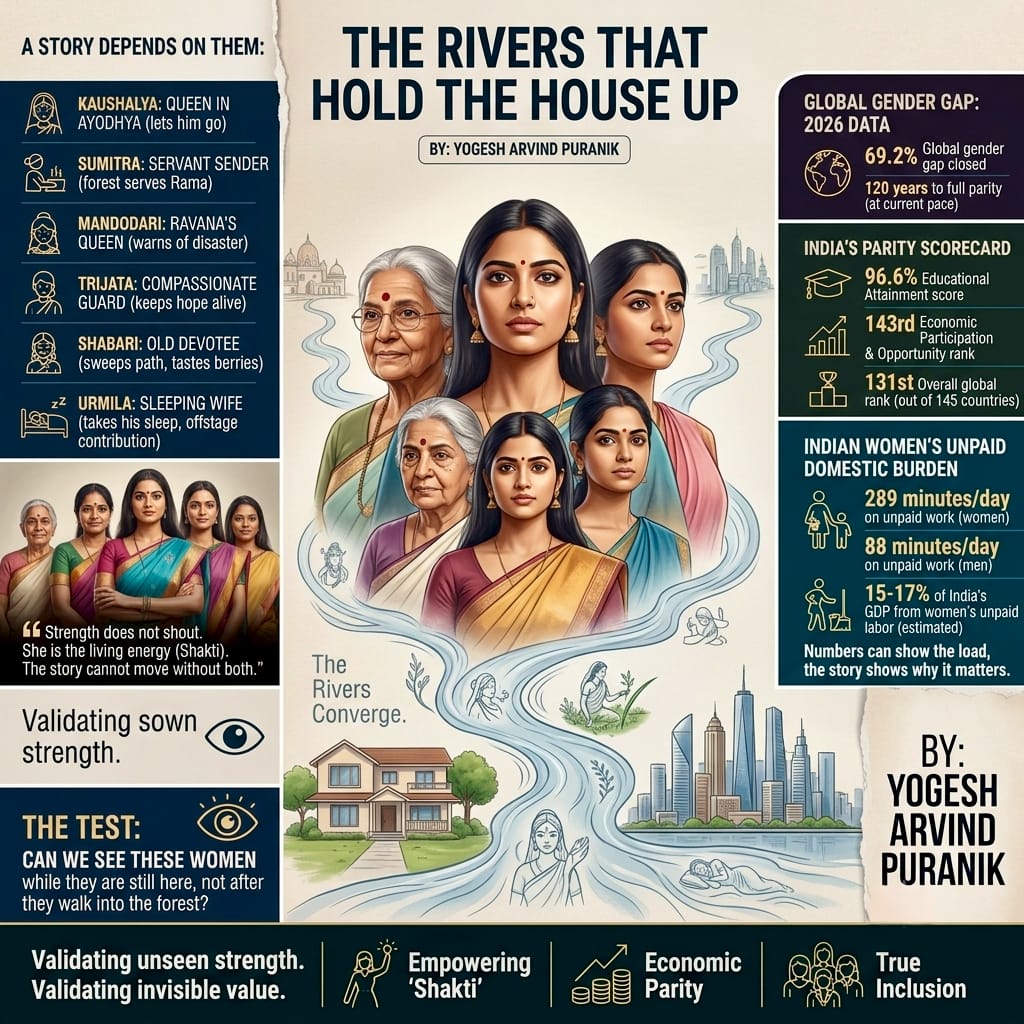
Start with Kaushalya, Rama’s mother. When her son is sent into fourteen years of exile, she weeps and questions, but she does not turn bitter. She lets him go.
Sumitra, the mother of Lakshmana, sends her son into the forest with one instruction: serve Rama as your father, Sita as your mother, and treat the forest as home. She does not make her own loss the center of the moment.
Mandodari, Ravana’s queen, sees the disaster coming long before it arrives. She warns her husband again and again. He does not listen, but she keeps telling the truth anyway.
Trijata, a guard in Ravana’s garden, refuses to join in the cruelty around her and quietly keeps Sita’s hope alive.
Tara, the queen of Kishkindha, begs her husband Vali not to enter a fight she can see he will lose. After he falls, she grieves fully, but she does not let her grief harden into bitterness.
Shabari, an old woman from a forest community, spends decades sweeping a path for a guest who may never come. When Rama finally arrives, she offers him berries she has tasted herself, and he accepts them because he understands what they carry.
Then there is Urmila, Lakshmana’s wife, whom the poets nearly forgot. Tradition says she took on his sleep for fourteen years so that he could remain awake and guard his brother. Her entire contribution happens offstage, and yet the story still depends on it.
In my book, there is a short section called “The Rivers Converge.” After meeting these women one by one, I ask the reader to look back at them together.
A queen in Ayodhya. A mother letting go. A wife inside Lanka. A guard in a garden. A grieving queen. A devotee in the forest.
Each carries one kind of wisdom. Kaushalya gives release, Sumitra gives service, Mandodari gives clarity, Trijata gives compassion, Tara gives grief that deepens instead of closing, and Shabari gives patient devotion.
None of them holds all of it.
All of it flows into Sita.
Sita is not a victim
Sita is often described as a princess who needed rescuing. The text shows something different.
When Rama is exiled, she does not wait to be told what to do. She says she is coming with him.
Raised by King Janaka, a ruler famous for remaining inwardly free while governing an entire kingdom, she learns that strength does not need to shout.
In the garden of Lanka, a king who possesses a golden city cannot get one thing from her: her consent.
In many tellings, she places a blade of grass between herself and Ravana and speaks past it, refusing to give him even her direct gaze.
In my reading, Sita stands for Pure Energy (Shakti), the living energy that turns awareness into action. Rama is the witness; Sita is the force.
The story cannot move without both.
The hard part of the story
An honest article has to admit that the Ramayana is not simply a celebration. After the war, Sita is asked to prove her purity by fire. Later, when gossip spreads, she is sent away to the forest while carrying Rama’s children.
Readers have argued about these scenes for centuries, and they should.
What I find striking is that the epic does not hide the pain or make it easy. It lets Sita walk away with her dignity intact, and it lets Rama live with his loss.
The story seems to be asking whether a society can recognize greatness when it is standing right in front of it.
That question is still open.
What the numbers say now
The same question can be asked of the modern world, and the data is sobering.
The World Economic Forum’s 2026 Global Gender Gap Report, its 20th edition, found that the global gender gap is 69.2 percent closed. At the current pace, full parity is still about 120 years away.
Progress is real, but slow.
Much of the gap comes down to the kind of work Urmila and Kaushalya did without a name.
Women continue to do far more unpaid care work than men, amounting to billions of hours every day worldwide. That imbalance affects who has the time and opportunity to take paid work.
Women are far more likely than men to remain outside the labour force because of unpaid care responsibilities.
In politics, the picture is similar. Women hold only a little over a quarter of parliamentary seats and just over a fifth of cabinet posts worldwide. Only a small number of countries are led by a woman.
Quotas can change representation. Parliaments and chambers with some form of quota have, on average, elected a higher proportion of women than those without one.
India today
India is a good place to see both halves of the story at once.
On education, women are close to equal. India scores 96.6 percent on educational attainment in the 2026 index. But India ranks 131st out of 145 countries overall, and on economic participation it ranks 143rd, with a parity score of 41.2 percent.
Women are educated, but many are still not in paid work.
Time explains a great deal of this. India’s Time Use Survey found that women spend 289 minutes a day on unpaid domestic work for their households, compared with 88 minutes for men.
One government-linked estimate puts the economic value of this work at 15 to 17 percent of India’s GDP.
That is a very large part of the economy that never appears on a payslip.
In politics, the picture is no different. The 18th Lok Sabha has 74 women among its 543 members, or 13.6 percent. The Women’s Reservation Act of 2023 promises to raise women’s representation.
Where the old story and the new data meet
The Ramayana was never a manual for equality in the modern sense, and I would not pretend otherwise.
But it did something that modern statistics keep trying to do. It made visible the work and wisdom that usually go unseen.
It said that the one who waits, the one who warns, the one who holds the household together, and the one who gives up her sleep are not minor characters.
They are the structure.
Numbers can show how unevenly the load is shared. A story can show why the load matters.
When we read that women do a vastly greater share of the world’s unpaid care work, we are reading a modern version of Urmila’s fourteen years.
The old poets left us with a simple test:
Can we see these women while they are still here, and not only after they walk into the forest?
The data suggests that we still have work to do.
The epic suggests that we have known the answer for a very long time.