
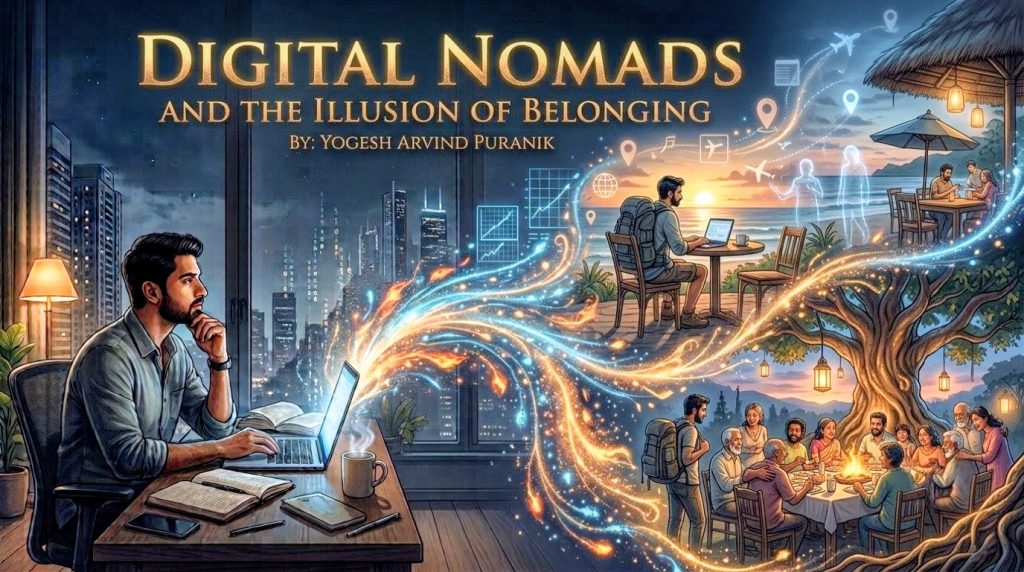
In the modern vocabulary of success, few ideas are as romanticized as the “digital nomad.” The picture is by now familiar: a laptop on a bamboo table in Bali, a half-zipped backpack in a Lisbon hostel, and the intoxicating promise that you can work from anywhere, answer to no address, and drift free of every ordinary constraint. Somewhere along the way, we decided that the highest form of freedom is perpetual motion.
But as this borderless life matures, a quieter crisis is surfacing among those who live it, and it is psychological rather than logistical. Those who are everywhere, it turns out, often belong nowhere.
Let us be fair to the dream before we question it. Remote work has opened doors that were shut for generations. It has let a young engineer in a small town earn a global salary without surrendering her home to a crowded metropolis. It has allowed caregivers, people with disabilities, and those priced out of expensive cities to build careers on their own terms. It has revived villages that were emptying out and given workers an escape from rigid offices and stifling hierarchies. For many, the freedom to choose where to live is no fantasy. It is dignity.
The trouble begins when that freedom hardens into a philosophy. The nomadic creed treats freedom as the absence of obligation: the right to leave a city, a friendship, or a community the moment it grows inconvenient or dull. This is a thin idea of liberty, closer to the freedom of a tourist than that of a citizen. It reduces the world to a succession of handsome backdrops to be consumed, when a place is really a living ecosystem that asks something of those who enter it.
A life in transit makes relationships transient by design. The nomad collects a wide, shallow network of fascinating acquaintances from co-working spaces and expat cafés, yet is quietly spared the friction of a rooted community, the very friction that gives it meaning. A shared Wi-Fi password is not belonging. Neither is a sunset yoga class with strangers who will be on a flight by Tuesday.
This is not merely a poet’s intuition. In 1995, the psychologists Roy Baumeister and Mark Leary reviewed decades of evidence and concluded that the need to belong is a fundamental human motivation, as basic as hunger. What we crave, they found, is not just contact but frequent, affectionate interactions within a relationship that is stable and ongoing, one in which people care about each other’s welfare. That is exactly what constant relocation makes difficult.
The stakes are physical as well as emotional. A widely cited 2010 meta-analysis by Julianne Holt-Lunstad and colleagues, covering more than 300,000 participants, found that people with stronger social relationships had a markedly better chance of survival than those with weaker ones, an effect comparable to well-known risks such as smoking. The Harvard Study of Adult Development, which has followed its participants for over eight decades, points the same way: the quality of our relationships predicts our health and happiness in later life better than wealth or career success. Research on residential mobility adds a sobering note. Studies by Shigehiro Oishi and others suggest that frequent moves can erode well-being, particularly for people who find it hard to make new friends quickly. The nomad’s loneliness, in other words, is not a personal failing. It is what the evidence would predict.
Belonging, then, is forged in the unglamorous work of staying. It grows when you remain long enough to settle a quarrel with a neighbor, to see a local project through from first idea to final result, and to let a landscape slowly imprint itself on you. It also demands a certain courage: the vulnerability of being truly known, rather than reinvented for the next time zone.
The cost of perpetual wandering is a creeping weightlessness. Without the gravity of a committed community, the self begins to feel scattered, a collection of versions left behind in different cities. We are social creatures, shaped over millennia to find our deepest meaning in what we owe one another, not in how skillfully we escape it.
None of this means the answer is to chain ourselves to a desk in the town of our birth. The problem is not movement. It is rootlessness. A person can travel widely and still belong somewhere: to a place they return to, a circle that expects them back, a community that notices when they are gone. Some of today’s wiser nomads have already learned this, trading the weekly flight for the long season, the hostel for the neighborhood, the audience for the friend. The question is not whether we may roam, but whether anyone is waiting at the other end of the journey.
As remote work puts geographic untethering within reach of millions, we should ask what, exactly, we are running from. Perhaps the most radical freedom on offer today is not the one-way ticket to anywhere. It may be the harder, quieter, countercultural choice to stay, to put down roots, and to take up the difficult and beautiful work of belonging to one corner of the earth.