
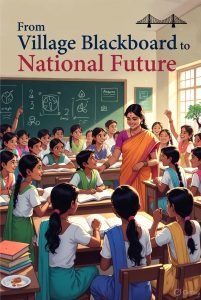
Imagine a small government school in a village not far from Kolkata. It’s 8:30 in the morning. A teacher named Meena arrives early, unlocks the classroom, and starts preparing the day’s lesson. Outside, a group of children — some barefoot, some carrying old school bags — walk in. Among them is 10-year-old Riya, whose parents work as daily wage labourers. Her mother often wonders whether sending her daughter to school is worth it when there’s work to be done at home or in the fields.
What makes Riya’s story different today is not just her determination. It is the invisible system of planning, rules, funding, and daily execution that we call public administration. This system decides that every child should get a free midday meal, that schools must stay open, that teachers get trained, and that learning should go beyond rote memorisation. Without these quiet administrative efforts, Riya might have dropped out long ago. With them, she has a real chance to dream bigger — perhaps becoming a nurse or a teacher herself.
Public administration is often misunderstood as dry paperwork or endless rules. In reality, it is the practical work of turning national dreams into everyday reality. In education, its goals are simple yet powerful: give every child a fair start, build useful skills for life and work, reduce inequality, and prepare responsible citizens who can keep India moving forward. These are not abstract ideas. They show up in the form of a hot meal on a plate, a new blackboard in a classroom, or a teacher learning new ways to explain fractions using local stories.
The Midday Meal That Changed Attendance
One of the most relatable examples is the Midday Meal Scheme. On paper, it is a nutrition programme. On the ground, it is often the single biggest reason many children — especially girls — come to school regularly.
Think about it from a parent’s point of view. When money is tight and food at home is uncertain, knowing your child will get at least one proper, cooked meal at school makes a huge difference. Studies and ground reports show enrolment and attendance rise significantly when the scheme works well. Girls benefit even more because families sometimes hesitate to send daughters far from home or spend on their education. A simple meal quietly challenges that hesitation.
Riya’s school serves rice, dal, and vegetables most days. On some days there are eggs or fruit. The children look forward to it. More importantly, they stay in class instead of feeling hungry and restless. Better nutrition also helps them concentrate. Teachers notice the difference — fewer sleepy faces, more participation. This is public administration achieving multiple goals at once: reducing hunger, improving learning, and slowly shifting social attitudes about educating girls.
NEP 2020: Moving from “Memorise and Forget” to “Understand and Apply”
For decades, many of us remember school as a place where we memorised answers for exams and forgot most of it afterwards. The National Education Policy 2020 tries to change that mindset through better administration and planning.
Instead of rigid streams (science or arts only after Class 10), it encourages flexibility. A student interested in both history and coding should be able to explore both. Learning should start with what children already know — their mother tongue or local language — before moving to other languages. There is more focus on understanding concepts, asking questions, and connecting classroom learning to real life.
Take the example of foundational literacy and numeracy. The policy and its implementation programmes like NIPUN Bharat push states to ensure every child can read and do basic maths by Class 3. In many schools, this means shorter, more engaging lessons, activity-based learning, and regular checks on whether children are actually grasping things — not just sitting through classes.
Teachers are being encouraged to move away from “chalk and talk” towards discussions, projects, and even mindfulness. This is where state-level public administration steps in — organising training, creating new teaching materials, and monitoring progress without burdening teachers with impossible targets.
The Happiness Curriculum: Teaching Children to Be Good Humans
In Delhi’s government schools, something beautiful and practical is happening every day. For 45 minutes, children from nursery to Class 8 do not study regular subjects. They learn about feelings, kindness, critical thinking, and how to handle everyday problems. It is called the Happiness Curriculum.
Teachers report that children become calmer, express themselves better, and show more respect towards each other and elders. One teacher shared that after these classes, students participate more in regular lessons too because they feel safer and more confident. Another noticed fewer fights during break time.
This is public administration at its thoughtful best. Someone in the education department decided that mental well-being and social skills are as important as marks. They designed a curriculum, trained thousands of teachers, and rolled it out across more than a thousand schools reaching over eight lakh children. The goal is not just better students — it is better future citizens who can handle stress, work in teams, and treat others with empathy. These are exactly the qualities needed in public life, workplaces, and families.
Building Skills and Breaking Barriers
Public administration also works on the bigger picture: preparing young people for jobs and reducing inequality. Vocational education is being strengthened so that a student who loves carpentry or coding does not have to feel it is “less than” studying for an engineering degree. Skill programmes, scholarships for marginalised communities, and efforts to bring back dropouts are all administrative tools aimed at one goal — giving everyone a ladder to climb.
When a first-generation learner from a small town or tribal area completes school and gets a decent job or starts a small business, it is not magic. It is the result of years of policy design, budget allocation, teacher posting, infrastructure building, and monitoring by administrators at district, state, and central levels.
The Challenges We Still Face — And Why We Must Care
Of course, things do not always go smoothly. Some schools still lack proper toilets or enough teachers. Plans made in Delhi or state capitals sometimes reach villages slowly. Digital tools help in many places but create new gaps where the internet or devices are missing. These are real problems that public administration itself must solve — through better coordination, more local decision-making, and listening to teachers and parents on the ground.
Yet the progress is visible. Dropout rates have come down in recent years. More girls are staying in school longer. States are experimenting with new ideas and sharing what works. The system is far from perfect, but it is moving.
Why This Matters to Every Indian
Education is not just about individual success. When Riya grows up educated and confident, she contributes to her family, her village, and the country. A better-educated population means a stronger economy, more informed voters, less easy spread of misinformation, and citizens who can demand better governance.
Public administration in education is like the roots of a huge banyan tree. You do not see most of the work, but without strong roots the tree cannot stand tall or spread its shade. When administrators plan well, implement fairly, and keep improving, the benefits reach every classroom — and eventually every home.
The next time you see children walking to school with their bags, or hear about a new training programme for teachers, remember that behind the visible change stands a whole machinery of public administration. Its goals are clear: no child left behind, every mind given a chance to grow, and a nation that becomes stronger because its people are educated not just in books, but in values, skills, and hope.
That is how public administration, working through the education system, helps turn today’s village blackboards into tomorrow’s national strength. And every one of us has a role — as parents, teachers, citizens, or future administrators — in making sure those roots keep growing deeper and stronger.