By: Yogesh Arvind Puranik
Education has always been one of the surest ways to change a life. For a woman, it can mean far more than a degree or a job. It can mean a say in her own decisions, money of her own, and the confidence to imagine a life bigger than the one she was handed.
India’s progress here is remarkable, but the story isn’t finished. More girls and women are filling classrooms, universities, and professional courses than ever before. And yet education doesn’t always turn into independence.
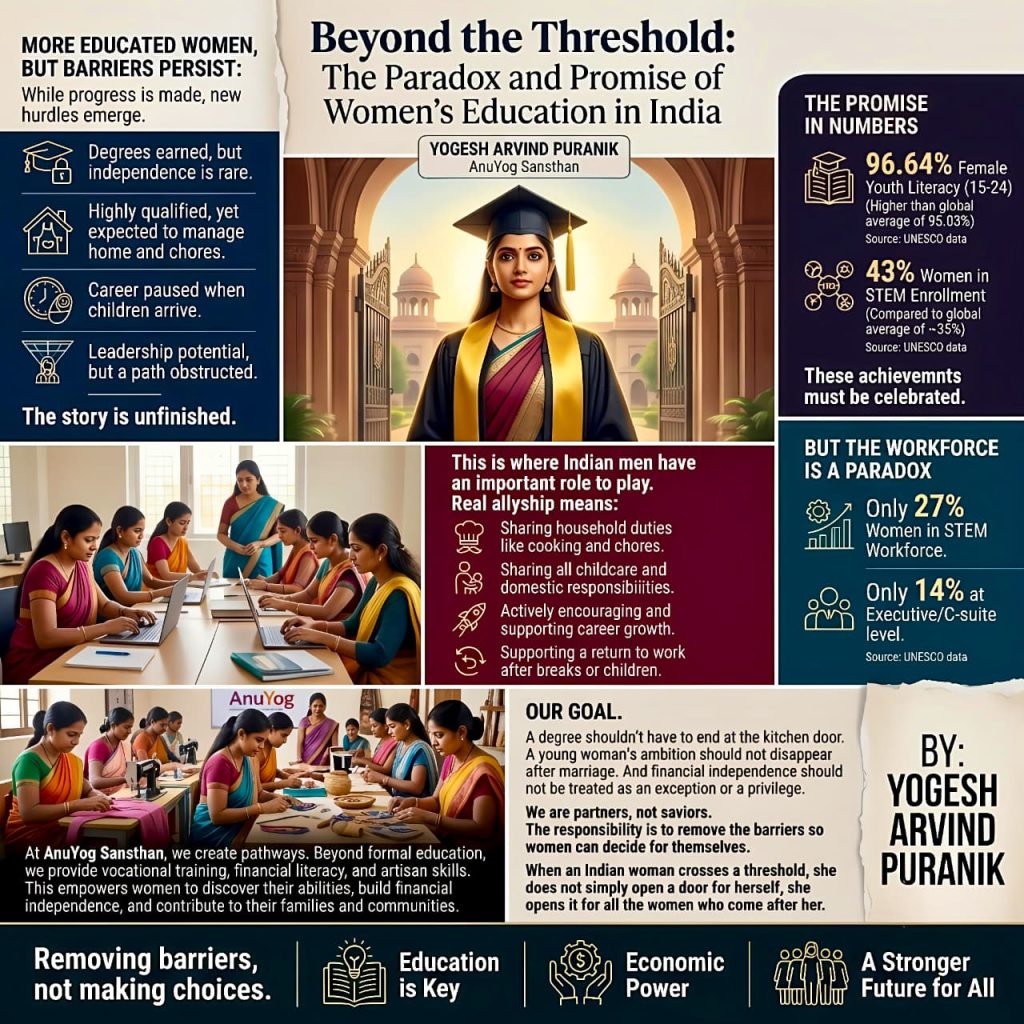
According to UNESCO, the literacy rate among young Indian women aged 15 to 24 stands at 96.64%, ahead of the global average of 95.03%. Technical education tells a similar story. Women make up about 43% of STEM enrollment in India, compared with roughly 35% worldwide. These numbers deserve to be celebrated.
But look at what happens next. Women hold only about 27% of STEM jobs in India, and in executive and C-suite roles the share drops to around 14%. Somewhere between the lecture hall and the boardroom, a great many women disappear.
So whether Indian women are getting educated is no longer the real question. Increasingly, they are. What matters is what happens once they leave the classroom.
A woman can finish her degree and still be expected to run the household. She can be brilliant and still be asked to pause her career when the children come. She can have every ounce of talent and ambition to lead, and still work in a place that was never built with her life in mind.
Men have a part to play here. Cheering on our daughters, sisters, wives, and colleagues while they study is not enough. We have to stand behind what comes after: the career, the ambition, the paycheck, the right to choose. That support starts at home.
When a man takes on his share of housework and childcare, he isn’t “helping out.” He is making room for a woman to grow in her work without being forced to pick between that and her family.
Allyship often looks very ordinary. It looks like cooking dinner, picking up the kids, making household decisions together, backing a wife who wants to go back to work, or encouraging a daughter toward a career people might call “unusual” for a woman. Small choices like these add up to something large.
This belief sits at the heart of my work with AnuYog Sansthan. We saw early on that formal education, essential as it is, doesn’t reach everyone equally. Many women, especially those from poorer families, never get to finish school or receive the training that could make them financially independent.
So at AnuYog Sansthan, we aren’t just teaching women new things. We’re helping them find abilities they never had the chance to develop. Through vocational training, financial literacy, artisanal skills, and technical education, we try to build routes by which women can earn, contribute, and take greater charge of their own futures.
Education becomes truly transformative when it gives a person choices. When a woman earns her own income, understands her finances, has a voice in household decisions, or builds something that is hers, the effect reaches well beyond her. Her family sees her differently. Her children grow up believing more is possible. Over time, a whole community can shift.
That’s why the aim can’t just be a higher count of educated women. We should want those women to be able to put their education to use. A degree shouldn’t stop at the kitchen door. A young woman’s ambition shouldn’t fade after her wedding. And financial independence shouldn’t be treated as a rare privilege.
Our job, as men and as a society, isn’t to speak for women or decide what is best for them. It’s to clear away whatever stops them from deciding for themselves. We don’t need to be saviors. We need to be partners.
Because when an Indian woman is educated, skilled, confident, and financially independent, she does more than cross a threshold. She holds the door open for the women who follow.