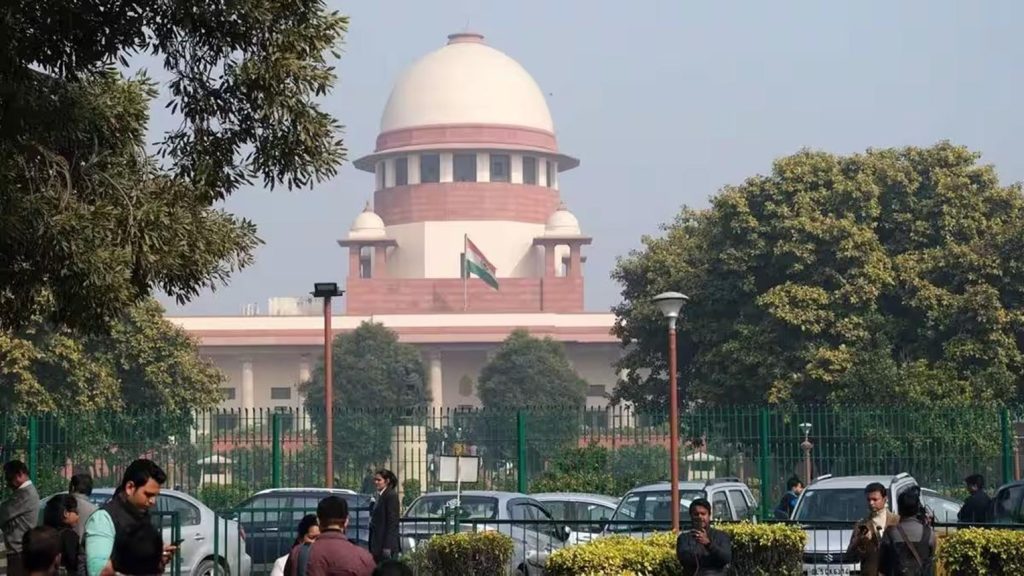
The Supreme Court of India on Tuesday, August 18, 2026, rejected a plea seeking to replace hanging with an alternative and potentially less painful method of executing death sentences, keeping hanging as the prescribed method of execution in the country for now.
A two-judge Bench comprising Justices Vikram Nath and Sandeep Mehta declined to refer the constitutional question to a larger Bench and held that there was insufficient basis to reopen the Supreme Court’s earlier position on hanging as a constitutionally valid mode of execution.
⚖️ What did the petition seek?
The petition was filed by advocate Rishi Malhotra and challenged the use of hanging as the method of execution for death-row prisoners.
The petitioner argued that hanging can involve pain and suffering and questioned whether the execution method adequately protects the dignity of a person even after a death sentence has been imposed. The plea sought consideration of alternatives including lethal injection, shooting and electrocution, among other methods.
The petition also challenged the relevant statutory provisions governing execution by hanging and argued that the manner of execution should meet constitutional protections under Article 21, which guarantees the right to life and personal liberty.
🏛️ Court declines larger Bench reference
A major part of Tuesday’s ruling was the Court’s refusal to refer the issue to a larger Bench.
The petition sought reconsideration of the earlier Dina v. Union of India ruling, which had upheld hanging as a constitutionally valid method of execution. The Bench of Justices Vikram Nath and Sandeep Mehta found no sufficient basis to reopen that precedent before a larger Bench.
As a result, hanging continues to be India’s prescribed method for carrying out civilian death sentences.
🔬 But the Supreme Court has not closed the debate permanently
The ruling is significant because the Court did not say that the question can never be reconsidered.
The Bench clarified that if compelling scientific, medical or empirical evidence emerges in the future demonstrating that the factual or scientific basis underlying the earlier Dina decision has been materially displaced, the constitutional question could potentially be examined again.
The Court also made clear that the Central Government is free to constitute an expert committee and undertake a comprehensive examination of alternative methods of execution if it chooses to do so.
In other words, Tuesday’s judgment maintains the status quo but leaves a possible route open for future scientific and policy-based reconsideration.
📜 The legal background
The debate over the method of execution is considerably older than the present case.
The Supreme Court had previously examined the constitutionality of hanging in Deena v. Union of India (1983). That judgment upheld hanging as a valid method of execution. The Court’s reasoning included the requirement that execution should be carried out in a manner consistent with constitutional safeguards.
Separately, in Bachan Singh v. State of Punjab, the Supreme Court established the well-known “rarest of rare” doctrine, under which the death penalty is to be imposed only in the most exceptional cases where the alternative of life imprisonment is unquestionably inadequate.
🚨 Important: The judgment was about the method, not abolition of the death penalty
Tuesday’s ruling should not be interpreted as a fresh Supreme Court ruling either abolishing or expanding capital punishment.
The petition before the Bench primarily concerned how a death sentence is carried out, rather than whether India should have the death penalty at all. The Statesman also notes that the case did not seek a ruling on the constitutional validity of capital punishment itself.
Thus, the immediate legal position remains:
Death penalty → remains legally available in India in appropriate “rarest of rare” cases.
Method of execution → hanging remains the prescribed method.
Future alternatives → the Centre may examine them, and the Court could revisit the issue if compelling new evidence emerges.
🕊️ Why the ruling matters
The judgment brings together two competing constitutional concerns: the punishment considered appropriate for exceptionally grave crimes and the dignity and suffering of a person facing execution.
Supporters of changing the method argue that advances in medicine and technology warrant a reassessment of whether hanging remains the most appropriate method. The petition itself relied on the possibility of alternative procedures that could reduce suffering.
The Court, however, stopped short of selecting an alternative method or directing the government to replace hanging. Instead, it has effectively placed the question back in the realm of future scientific evidence, government policy and possible constitutional review.
📰 Bottom Line
The August 18, 2026 Supreme Court ruling keeps hanging as India’s method of executing death sentences, rejecting the immediate demand for a more “painless” or “dignified” alternative. At the same time, the Court has deliberately left the issue open to future reconsideration if credible scientific, medical or empirical evidence establishes that another method would substantially reduce suffering and better protect human dignity.