
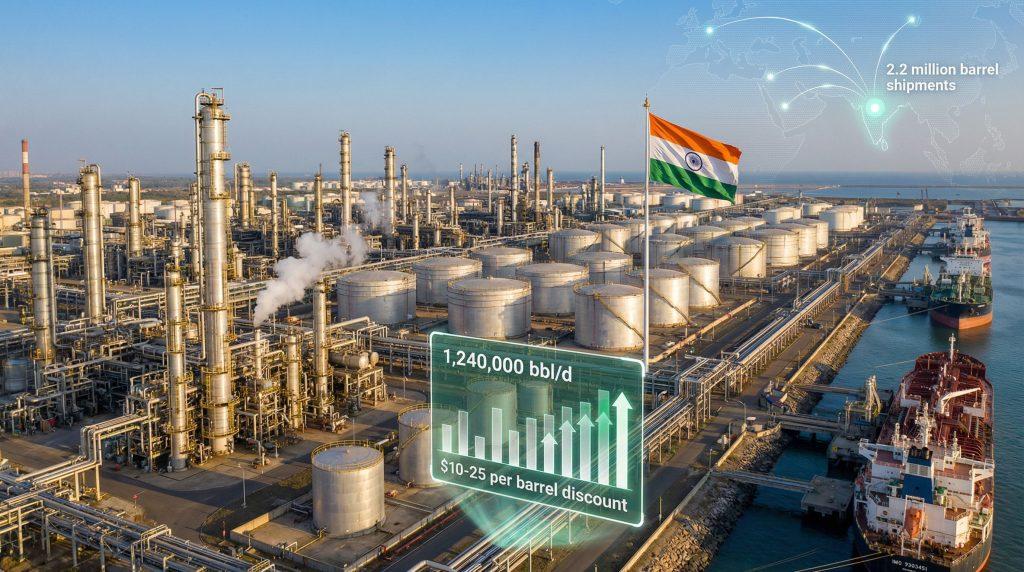
Move Could Put Fresh Pressure on India’s Russian Oil Purchases and India-US Trade
A major development in Washington could have significant economic implications for India after the US Senate approved a Russia sanctions bill by an overwhelming 86–11 vote.
The legislation, known as the Lindsey O. Graham Sanctioning Russia and Iran Act, targets Russia and countries that continue purchasing Russian energy. If ultimately enacted and implemented, it could give the US president the authority to impose tariffs of up to 100% on imports from countries buying Russian petroleum and other targeted Russian energy products.
India is among the countries that could be affected because Indian refiners have historically purchased substantial quantities of Russian crude oil.
The issue is particularly sensitive because Russian crude became an important source for Indian refiners after the Russia-Ukraine war disrupted global energy markets. Buying discounted Russian crude has helped Indian refiners manage costs and maintain supplies.
What the Senate vote means
It is important to distinguish between Senate approval and an immediate tariff.
The Senate vote does not itself mean that a 100% tariff has been imposed on India today. Rather, it advances legislation that could provide the US administration with considerably stronger tools to penalise countries continuing to purchase Russian energy.
India’s potential exposure is therefore dependent on the bill’s further legislative and executive steps and on how its provisions are ultimately implemented.
Why India is concerned
The US is one of India’s largest export markets. A very high additional tariff on Indian goods entering the US could affect sectors that depend heavily on American consumers.
Potentially affected industries could include textiles and apparel, engineering goods, pharmaceuticals, chemicals, gems and jewellery and other manufactured products, depending on how any future measures are structured.
The development also comes against the backdrop of already complicated India-US trade negotiations.
For India, the challenge is to balance three objectives:
- maintaining affordable and reliable energy supplies;
- protecting strategic relations with Russia;
- and avoiding further disruption to its important trade relationship with the United States.
The development could therefore become a significant test for India’s foreign-policy principle of maintaining strategic autonomy.